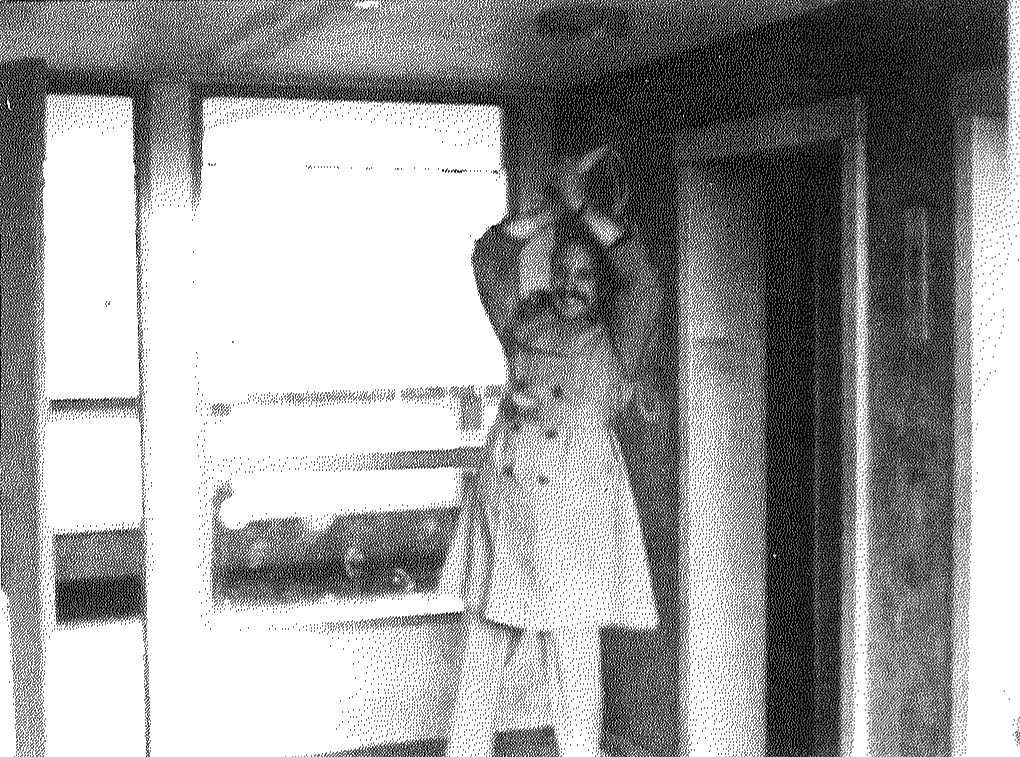
"In order to really appreciate architecture you might even have to commit a murder", wrote Bernard Tschumi in his book Questions of Space. Leafing through a slightly dog eared copy of The Language of Post Modern Architecture (as you do) I came across an odd piece of evidence of exactly that. In the grainy shot above New York Times architecture critic Paul Goldberger mimes the act of murdering someone in one of the stair lobbies of Alison and Peter Smithson's Robin Hood Gardens.
Presumably the point Goldberger was trying to make was that Robin Hood Gardens was a muggers paradise. His pretend violence was aimed as much at the architecture as it was some phantom victim and in that sense acts as an eerie premonition of the buildings likely demolition. The photograph is included in a chapter called The Death of Modern Architecture and fits into a familiar enough story about the perceived failure of streets in the sky, lack of defensible space and other sins of brutalism. But, as the recent ongoing refurbishment of the Smithsons inspired Park Hill in Sheffield prove, the problems of this kind of modernism are more about taste than they are about space. By which I mean, for people who want to live there and who can now afford to, Park Hill is a viable form of housing*.
The current obsession with systems of spatial control and surveillance in new housing developments (documented recently by Anna Minton) are supposed to eradicate the chances of Goldberger style anti-social behaviour occurring. Criteria like Secured by Design (where police officers vet architect's designs) co-opt architecture as a (supposedly) benign agent of law enforcement. In doing so they suggest that it's possible to design out crime. Instead of locating criminality within a socio-economic context measures like SBD blame it on recessed entrance ways and an overabundance of spaces for 'lurking'. Which also neatly aligns safety and security with conventional architectural styles - front doors to the street, low rise developments etc.
Isn't architecture then a pretty innocent victim in all this, forced to play the blame of villain for societies wider inequalities? A colonnade, for instance, is both a charming place for a pavement cafe or a lurkers paradise, depending on your location. The colonnades of Portland Place were, infamously, designed to eradicate the possibility of undesirables lurking in them. Which suggests that there is a certain causal relationship between architectural form and social behaviour, even if it might be overstated.
Architects, with their privileging of space (form) over taste (culture), unwittingly play themselves into a reactionary trap here. If places or buildings are perceived to have 'failed' it is because of their failings as architecture rather than the failings of the culture that inhabits them. Just as politicians deny the causal relationship between poverty and crime (because it is clearly convenient to do so), demonising any number of scapegoats (TV, drugs etc.) social inequalities become blamed on architecture.
Tschumi went on to say: "Murder in the street differs from murder in the cathedral". That would depend on whether you're the victim or not.
* This doesn't mean that it isn't viable otherwise, merely that it has been starved of the kind of upkeep that all buildings require.
Presumably the point Goldberger was trying to make was that Robin Hood Gardens was a muggers paradise. His pretend violence was aimed as much at the architecture as it was some phantom victim and in that sense acts as an eerie premonition of the buildings likely demolition. The photograph is included in a chapter called The Death of Modern Architecture and fits into a familiar enough story about the perceived failure of streets in the sky, lack of defensible space and other sins of brutalism. But, as the recent ongoing refurbishment of the Smithsons inspired Park Hill in Sheffield prove, the problems of this kind of modernism are more about taste than they are about space. By which I mean, for people who want to live there and who can now afford to, Park Hill is a viable form of housing*.
The current obsession with systems of spatial control and surveillance in new housing developments (documented recently by Anna Minton) are supposed to eradicate the chances of Goldberger style anti-social behaviour occurring. Criteria like Secured by Design (where police officers vet architect's designs) co-opt architecture as a (supposedly) benign agent of law enforcement. In doing so they suggest that it's possible to design out crime. Instead of locating criminality within a socio-economic context measures like SBD blame it on recessed entrance ways and an overabundance of spaces for 'lurking'. Which also neatly aligns safety and security with conventional architectural styles - front doors to the street, low rise developments etc.
Isn't architecture then a pretty innocent victim in all this, forced to play the blame of villain for societies wider inequalities? A colonnade, for instance, is both a charming place for a pavement cafe or a lurkers paradise, depending on your location. The colonnades of Portland Place were, infamously, designed to eradicate the possibility of undesirables lurking in them. Which suggests that there is a certain causal relationship between architectural form and social behaviour, even if it might be overstated.
Architects, with their privileging of space (form) over taste (culture), unwittingly play themselves into a reactionary trap here. If places or buildings are perceived to have 'failed' it is because of their failings as architecture rather than the failings of the culture that inhabits them. Just as politicians deny the causal relationship between poverty and crime (because it is clearly convenient to do so), demonising any number of scapegoats (TV, drugs etc.) social inequalities become blamed on architecture.
Tschumi went on to say: "Murder in the street differs from murder in the cathedral". That would depend on whether you're the victim or not.
* This doesn't mean that it isn't viable otherwise, merely that it has been starved of the kind of upkeep that all buildings require.


.jpg)