
Will Self wrote a piece in last week's Guardian Review about his interest in scale and love of miniatures and models. I'm not a huge (ho ho) fan of Self's writing but I do remember enjoying his short story called Scale - about a man who lives in a bungalow adjacent to Bekenscot Model Village - and I share his obsession with the subject.
Miniatures and models seemed to feature in my recent holiday to an unnerving degree too. It was the sort of thing that might happen to a character in a Will Self story, in fact, someone slowly losing their sense of scale until they become stuck in a terrifyingly cheery miniature world populated by old ladies on stationary bicycles, firemen forever putting out the same fire and aeroplanes unable to take off.

All this can be partially explained by the fact that I spent my holiday by the English coast. Seaside towns in the UK are home to numerous miniature golf courses, model villages and small-scale steam railways. On holiday the routines and objects of one's working life are replaced with larger - or smaller - than life versions of reality.

The Romney, Hythe and Dymchurch Railway is a 15 inch gauge steam railway that is also a working piece of infrastructure: a functional toy. Its trains puff alongside the sand and shingle beaches between Dymchurch and Dungeness, transporting holiday makers - and others - along 13 1/2 miles of the East Kent coast.

What's interesting, and a little bit odd about the RHDR is that its journey is for the most part thoroughly un-picturesque. The sea is always nearby but rarely visible and the trains rattle along past suburban back gardens, through flat and undramatic farmland and, finally, across the bleak shingle spit of Dungeness. The fact that the final destination is a nuclear power station seems oddly fitting. It takes a long time too - over an hour - to complete one leg of the journey and it is not, in any particularly obvious sense, entertaining.

In some of the gardens en route residents have built miniature stations with platforms occupied by smiling and waving garden ornaments. Some have gone further and built their own miniature railway. There is a pleasingy Doctor Who-ish quality to all this, a series of ever diminishing scales that may well end in an infinitesimally tiny train set hidden under a skirting board and capable of tilting the earth off its axis. Possibly.

In some of the gardens en route residents have built miniature stations with platforms occupied by smiling and waving garden ornaments. Some have gone further and built their own miniature railway. There is a pleasingy Doctor Who-ish quality to all this, a series of ever diminishing scales that may well end in an infinitesimally tiny train set hidden under a skirting board and capable of tilting the earth off its axis. Possibly.

Everything associated with the RHDR railway is built to the same scale and with the same degree of thoroughness so that to take a journey on it is to effectively occupy a series of spaces that you don't quite fit into. Judging distance and speed stops being a matter of habit and becomes oddly foregrounded so that it takes a degree of mental effort to work out how far or near things are away from you. The whole place is mildly disorientating in way which betrays its origins in the Edwardian whimsy of Peter Pan and The Wind In The Willows.

Equally, there is a matter of factness about it all, and the pragmatic day to day activities of a railway - the repair sheds and stacks of replacement sleepers and even freight engines - are realised at the same scale without a hint of kitsch.

We didn't make it as far as Dungeness and got off at New Romney, which was fine because it meant that we could visit the New Romney Toy Museum. Well, it wasn't entirely fine because New Romney station is in the middle of nowhere, several miles from either a beach or town, neither of which are much to write home about when you get there. The museum itself was small but normal scale. It also answered A A Gill's recent criticism of Bethnal Green Museum of Childhood (not enough guns) by being more of a Boy Museum, filled with toy cars, trains, rockets and steam radios.

There were also models of docks and industrial ports, power plants and cooling towers, all sorts of things in fact that no one would dream of making a toy of now, and not only because they increasingly don't exist (well the industrial ports at least). There is something about the specificity and literalness about old toys that makes them fascinating. They are not even toys exactly, at least not in the contemporary sense of things that are fun or immediately entertaining. They're closer to educational objects, factual representations of industry, science and technology as opposed to the spectacular and fictional ones of today.

That's not to say that they didn't contain a science fiction element but that, when they did, it was usually with a jolly and optimistic tone that its hard to see in Transformers or, most especially, something like Wall-E. I particularly liked the stylish 2000AD style font of Computacar's packaging though, and the inference that in the future there will be no 'E's'.

The museum also had an extensive miniature railway all of its own, a Hornby sized version that wound itself around the room in a fantastic display of the amateur model makers art.

The model represented a collapse of both space and time. Men in 1970's suede car coats parked up their Ford Cortinas to watch pre-war steam trains rattle through a countryside caught in some mid-twentieth century idyll. Elsewhere, 1950's cars and caravans set up camp next to gas cylinders and power station cooling towers...

For some reason this scene reminded me of David Fincher's film Zodiac. Something sinister lurks in those miniature bushes.

The museum also contained historic photographs of the light railway. It has, at times, been used to transport ballast, fish, army troops and the Royal Mail. When it was extended - in 1937 - to reach Dungeness, Laurel and Hardy were invited to open the new line. More bizarrely still, it formed a part of the defence of the Kent coast during WW2, when a miniature armoured train would patrol its length.

Outside the museum parked in the New Romney sidings was a model of the armoured train - another model of a model in fact - a plywood replica painted in silver that is slowly flaking off.

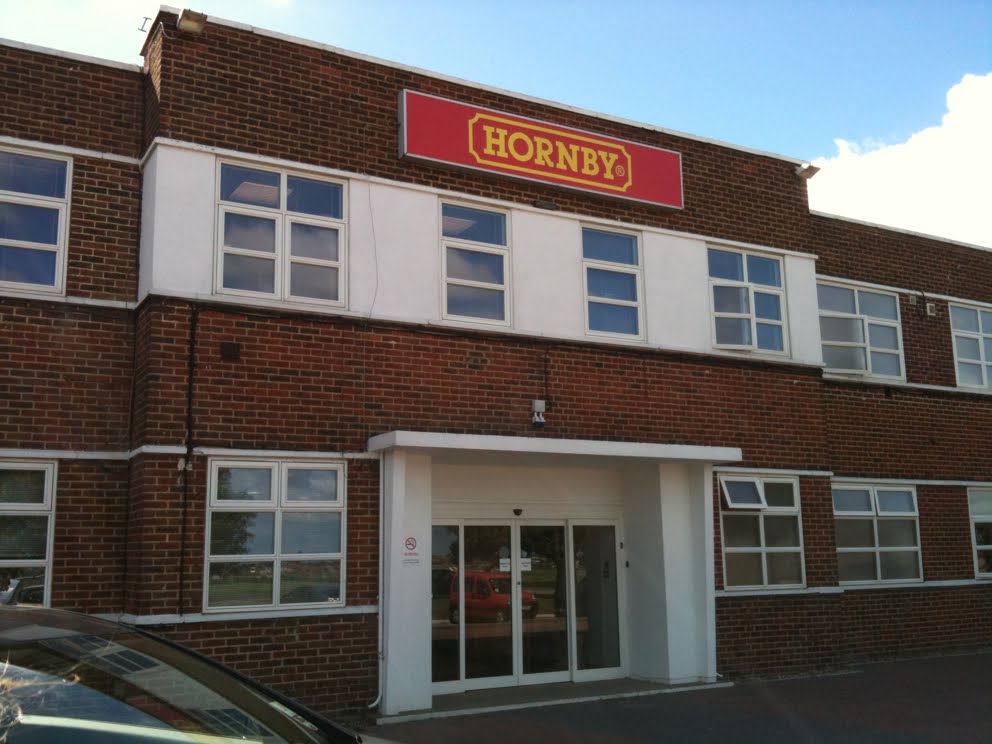
A few days later, and back using regular sized transport we passed Hornb's rather Sun-shine Deserts-ish stripped deco factory outside Broadstairs. The factory has a visitor centre attached now so we decided to follow in Bernard Cribbins' Hornby sized shoes and immerse ourselves in its miniature world.
Inside they had created a slightly menacing and under-populated night-time scene of a northern English city. A couple argues on the street...

...while trucks pull up at an all-night distribution warehouse.

The moulds for the cars were in many ways more interesting than the toys themselves. Their opaque windscreens and the way the shapes emerged from solid lumps of plastic was oddly disturbing and reminded me of Richard Prince's car body part sculptures.

But there was something very beautiful about the older toys themselves, often a result of the relative crudity of earlier modelling techniques. Some of the ones from the 1950's and early '60's had an absence of detail that made them seem semi-abstract, more like expressionist impressions of speed and aerodynamics than accurate models.

Other exhibits seemed imbued with the specific obsessions of previous eras, like this little collection of 1970's outdoor camping chic. Behind the Bond Bug and the lady on the sunlounger is a set of safari park vehicles from Longleat or somewhere similar, surely something no one would consider making a toy of today.

I bought myself a present from the gift shop. It was the most humdrum and wonderfully mundane object I could find; a Car Sales Portacabin. My wife looked at me somewhat pityingly when I showed it to her and asked if I had anything else I wanted to admit to.

A fondness for models and miniatures is a dangerous thing to admit to. There is an un-worldliness to it, a sense of childish retreat from adult concerns. No doubt there is an element of truth to this, but I also like the uncanny qualities of models and the fact that they are frequently and interestingly wrong.
Because miniatures (and giants) are translations - that is, versions of other pre-existing objects - something tends to get lost - or added to - along the way. So, models are as much about how we see things as they are objects in their own right. Making an object at the wrong scale removes it from the real world, so that it becomes an object of contemplation, a way of reflecting upon the things that we normally only experience in a blur of habit.
That's my excuse anyway.


