Showing posts with label miniatures. Show all posts

Tuesday, September 7, 2010

days in toyland


Will Self wrote a piece in last week's Guardian Review about his interest in scale and love of miniatures and models. I'm not a huge (ho ho) fan of Self's writing but I do remember enjoying his short story called Scale - about a man who lives in a bungalow adjacent to Bekenscot Model Village - and I share his obsession with the subject.

Miniatures and models seemed to feature in my recent holiday to an unnerving degree too. It was the sort of thing that might happen to a character in a Will Self story, in fact, someone slowly losing their sense of scale until they become stuck in a terrifyingly cheery miniature world populated by old ladies on stationary bicycles, firemen forever putting out the same fire and aeroplanes unable to take off.


All this can be partially explained by the fact that I spent my holiday by the English coast
. Seaside towns in the UK are home to numerous miniature golf courses, model villages and small-scale steam railways. On holiday the routines and objects of one's working life are replaced with larger - or smaller - than life versions of reality.


The Romney, Hythe and Dymchurch Railway is a 15 inch gauge steam railway that is also a working piece of infrastructure: a functional toy. Its trains puff alongside the sand and shingle beaches between Dymchurch and Dungeness, transporting holiday makers - and others - along 13 1/2 miles of the East Kent coast.


What's interesting, and a little bit odd about the RHDR is that its journey is for the most part thoroughly un-picturesque. The sea is always nearby but rarely visible and the trains rattle along past suburban back gardens, through flat and undramatic farmland and, finally, across the bleak shingle spit of Dungeness. The fact that the final destination is a nuclear power station seems oddly fitting. It takes a long time too - over an hour - to complete one leg of the journey and it is not, in any particularly obvious sense, entertaining.


In some of the gardens en route residents have built miniature stations with platforms occupied by smiling and waving garden ornaments. Some have gone further and built their own miniature railway. There is a pleasingy Doctor Who-ish quality to all this, a series of ever diminishing scales that may well end in an infinitesimally tiny train set hidden under a skirting board and capable of tilting the earth off its axis. Possibly.


Everything associated with the RHDR railway is built to the same scale and with the same degree of thoroughness so that to take a journey on it is to effectively occupy a series of spaces that you don't quite fit into. Judging distance and speed stops being a matter of habit and becomes oddly foregrounded so that it takes a degree of mental effort to work out how far or near things are away from you. The whole place is mildly disorientating in way which betrays its origins in the Edwardian whimsy of Peter Pan and The Wind In The Willows.


Equally, there is a matter of factness about it all, and the pragmatic day to day activities of a railway - the repair sheds and stacks of replacement sleepers and even freight engines - are realised at the same scale without a hint of kitsch.


We didn't make it as far as Dungeness and got off at New Romney, which was fine because it meant that we could visit the New Romney Toy Museum. Well, it wasn't entirely fine because New Romney station is in the middle of nowhere, several miles from either a beach or town, neither of which are much to write home about when you get there. The museum itself was small but normal scale. It also answered A A Gill's recent criticism of Bethnal Green Museum of Childhood (not enough guns) by being more of a Boy Museum, filled with toy cars, trains, rockets and steam radios.


There were also models of docks and industrial ports, power plants and cooling towers, all sorts of things in fact that no one would dream of making a toy of now, and not only because they increasingly don't exist (well the industrial ports at least). There is something about the specificity and literalness about old toys that makes them fascinating. They are not even toys exactly, at least not in the contemporary sense of things that are fun or immediately entertaining. They're closer to educational objects, factual representations of industry, science and technology as opposed to the spectacular and fictional ones of today.


That's not to say that they didn't contain a science fiction element but that, when they did, it was usually with a jolly and optimistic tone that its hard to see in Transformers or, most especially, something like Wall-E. I particularly liked the stylish 2000AD style font of Computacar's packaging though, and the inference that in the future there will be no 'E's'.


The museum also had an extensive miniature railway all of its own, a Hornby sized version that wound itself around the room in a fantastic display of the amateur model makers art.


The model represented a collapse of both space and time. Men in 1970's suede car coats parked up their Ford Cortinas to watch pre-war steam trains rattle through a countryside caught in some mid-twentieth century idyll. Elsewhere, 1950's cars and caravans set up camp next to gas cylinders and power station cooling towers...


For some reason this scene reminded me of David Fincher's film Zodiac. Something sinister lurks in those miniature bushes.


The museum also contained historic photographs of the light railway. It has, at times, been used to transport ballast, fish, army troops and the Royal Mail. When it was extended - in 1937 - to reach Dungeness, Laurel and Hardy were invited to open the new line. More bizarrely still, it formed a part of the defence of the Kent coast during WW2, when a miniature armoured train would patrol its length.


Outside the museum parked in the New Romney sidings was a model of the armoured train - another model of a model in fact - a plywood replica painted in silver that is slowly flaking off.


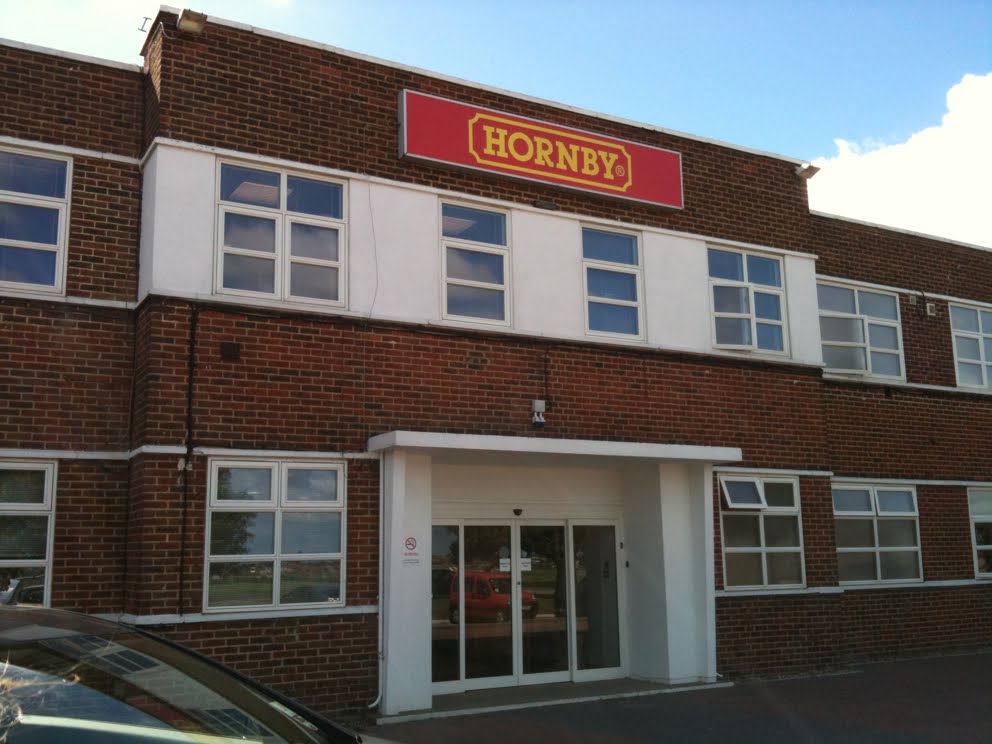
A few days later, and back using regular sized transport we passed Hornb's rather Sun-shine Deserts-ish stripped deco factory outside Broadstairs. The factory has a visitor centre attached now so we decided to follow in Bernard Cribbins' Hornby sized shoes and immerse ourselves in its miniature world.


Inside they had created a slightly menacing and under-populated night-time scene of a northern English city. A couple argues on the street...


...while trucks pull up at an all-night distribution warehouse.


The moulds for the cars were in many ways more interesting than the toys themselves. Their opaque windscreens and the way the shapes emerged from solid lumps of plastic was oddly disturbing and reminded me of Richard Prince's car body part sculptures.


But there was something very beautiful about the older toys themselves, often a result of the relative crudity of earlier modelling techniques. Some of the ones from the 1950's and early '60's had an absence of detail that made them seem semi-abstract, more like expressionist impressions of speed and aerodynamics than accurate models.


Other exhibits seemed imbued with the specific obsessions of previous eras, like this little collection of 1970's outdoor camping chic. Behind the Bond Bug and the lady on the sunlounger is a set of safari park vehicles from Longleat or somewhere similar, surely something no one would consider making a toy of today.


I bought myself a present from the gift shop. It was the most humdrum and wonderfully mundane object I could find; a Car Sales Portacabin. My wife looked at me somewhat pityingly when I showed it to her and asked if I had anything else I wanted to admit to.


A fondness for models and miniatures is a dangerous thing to admit to. There is an un-worldliness to it, a sense of childish retreat from adult concerns. No doubt there is an element of truth to this, but I also like the uncanny qualities of models and the fact that they are frequently and interestingly wrong.

Because miniatures (and giants) are translations - that is, versions of other pre-existing objects - something tends to get lost - or added to - along the way. So, models are as much about how we see things as they are objects in their own right. Making an object at the wrong scale removes it from the real world, so that it becomes an object of contemplation, a way of reflecting upon the things that we normally only experience in a blur of habit.

That's my excuse anyway.

Wednesday, July 14, 2010

Model Behaviour


I'm off to Legoland this Friday, supposedly to accompany my daughter on her school trip but actually to undertake some serious blogospherical research into miniatures, souvenirs, model villages and all that kind of thing. Expect a miniature photo-essay and a bored eight year old as a result.

All of which reminds me of Fabian Mortitz's Lego recreations of World Cup games over the last month, viewable on The Guardian's website. The Spain versus Holland final is embedded below (in which you gotta love Sergio Ramos' long Lego locks and, equally, Arjen Robbens lack of them in the team line up right at the start). There's something about these recreations and the way they reduce the intense drama, physical effort and virulent nationalism of the World Cup into bathetic absurdity which makes them a kind of necessary antidote.

Which is a sort of fitting send(ing) off for Minus the Shooting, which I understand is going out with a bang rather than a whimper this week after providing some of the most interesting writing about the World Cup online. Giovanni's (possibly final) post about simulations and recreations of football games is particularly good and possibly worthy of some kind of follow up here if I can do it justice. It also made me realise just how much more there is to write on the topic, stuff about team strips, fans, flags and the cultural mediation of football in general. Anyway, go read, and watch.


Monday, March 29, 2010

In Godshill Country

I came across these pictures recently and thought I'd post them up. They're from Godshill Model Village, on the very strange Isle of Wight (which you can read more about here). I tend to prefer my miniature landscapes a bit less cute generally - check out Madurodam in Holland with its miniature miles of reclaimed polder land and container ports, or this beauty - but there's something about the overabundant landscaping at Godshill that is mildly surreal at least.


There is something inherently inherently peculiar about a model village on the Isle of Wight, mainly because the island itself is a sort of miniature version of the UK. The relationship between the two is curiously inverted in the phrase "You can put the whole of England on the Isle of Wight", which forms the starting point for Julian Barnes' slightly leaden satire on theme parks, fakes and copies England, England. In the book a miniaturised theme park version of England is constructed on the Isle of Wight and gradually starts to replace the real thing.


It's the odd, left-over bits I always enjoy the most though. The back of a pub, or a deserted station car park. It's nice that someone went to the effort of making them and getting the particular quality of forlornness, or the colour of the drainpipes, just right.


There comes a moment in every model village where the carefully contrived scaled down world is fatally unbalanced by the intrusion of a real object. Normally this is a human sized foot, or a hungry blackbird, but there are subtler signs such as super sized raindrops or some peculiarly large and unconvincing rocks.


Some suitably heroic engineering spans across the rockery and takes the railway over the algae filled lagoon. No sign of a 1:25 scale model of Richie Edwards' car nearby though...


The verisimilitude of this section of the village suffers from the size of the concrete aggregate in the road. The wind farm also sounds an oddly contemporary note in a village otherwise dedicated to representing an agreeable 1950's utopia of butcher's delivery vans and plentiful cake.


Finally, what all miniature villages need, a miniature airport. Question is, where do they fly to?

Wednesday, November 18, 2009

"This Means Something!"

http://alethakuschan.files.wordpress.com/2008/05/dreyfus-without-the-mashed-potatoes.jpg
"I figured it out, that's all. Will you just listen?... Have you ever looked at something and it's crazy, and then you looked at it in another way and it's not crazy at all?... Don't be scared. Just don't be scared. I feel really good. Everything's gonna be all right. I haven't felt this good in years."

I watched Close Encounters of the Third Kind again the other day. It's a fabulous film in many ways, imbued with an almost lyrical technological optimism. Despite coming from a golden age of cinematic science-fiction, it's completely different in tone to anything else from the period. While Star Wars, for example, can be read as an allegory for the Cold War and America's struggle against another Evil Empire, Close Encounters is a plea for tolerance and understanding. Even the military appear relatively benign in it.

https://blogger.googleusercontent.com/img/b/R29vZ2xl/AVvXsEgcX0-mDDTsfmOPp3nj4RBis-Q_4oSlaRS0trE3neMGx0aTJXqo150qw0M2x4_Vkwl5H5baz7mNaBuCFPdiY6TnlNOvUJlQNrMdizdyeZNc2ipy2rRmyWui1yyG5LcGdYNYHkNvs9_Px5Yk/s320/Apicella+Hitchcock+The+Pathos+of+Richard+Dreyfus.jpg

It can also be seen as having another, more unlikely, sub-text; one about issues of representation and communication. The film's central character is Roy Neary (played by Richard Dreyfus). Following a close encounter with an alien spaceship Roy becomes obsessed with visions of a strange, mountainous formation. He notices this shape everywhere: in the folds of his pillows, in the blob of aftershave in his hand and in a mound of mashed potatoes on his plate.

http://www.ugo.com/movies/creation-scenes/images/entries/close-encounters-of-the-third-kind.jpg

He starts to create maquettes of it in clay which become ever larger and more elaborate. Eventually, having alienated his entire family to the point where they move out, he creates an enormous model that fills his entire house. To make this model he ransacks the garden for materials, chucking them through a broken window into the living room to the horrified bemusement of his neighbours.

The resulting model is an utterly fabulous object, a grotesque assemblage of mud, vegetation, rubble, furniture and bits of string. It is both mimetically accurate (as we and Roy will later find out) and highly expressionistic, as if created by a bizarre hybrid of Robert Smithson, Jessica Stockholder and an acid-crazed model railway enthusiast.

Just as Roy is nearing the completion of this extraordinary object he realises what it means. The TV that he has blaring in the corner of the otherwise devastated living room has a news report about a bizarre shaped rocky outcrop in Wyoming. Roy looks at the footage of Devil's Tower and then back at his creation. He sits down in shock.

http://www.filmsquish.com/guts/files/images/3rd%201.jpg

In some senses Roy is like a typically Hollywood-ian depiction of the artist: a half-crazed, anti-social lunatic in search of some intangible truth. Except he isn't an artist. Nor is he mad, just a little intense. And the film also wants us to take him seriously. His sculpture, as he repeatedly explains whist making it, really does mean something.

http://dvdmedia.ign.com/dvd/image/article/838/838392/close-encounters-of-the-third-kind-30th-anniversary-ultimate-edition-20071128021143639-000.jpg

The film is obsessed with issues of representation and non-verbal communication. The famous five-note score that the scientists use to communicate with the aliens, for example, effectively replaces speech. The chief scientist is a Frenchman (played by film director François Truffaut) who makes no more than one or two gnomic utterances and is accompanied throughout the film by an ineffectual translator. The fact that none of the Americans can understand him seems to imbue him with some special understanding of what is going on.

Roy can't communicate his obsession through conventional language and is forced into non-verbal communication. He has to make what he is thinking in order to express it. And he's not alone in his obsession. Another character - Gillian Guiler - is also obsessed with Devil's Tower. She draws it over and over again. In a brilliant scene the two of them converge on Devil's Tower aware that it's the location for the alien spaceship's landing. Trying to work out how to scale the mountain Roy reveals that his knowledge of its topography is vastly superior to Gillian's. "You should try sculpture next time", he deadpans.

In making a plea for tolerance the film also seems to implicitly reject language, as if our primary means of communication were somehow ultimately a handicap to understanding. Language seems to dissolve during the film, becoming ever more useless until it dissipates into the abstract lights and sounds used by the scientists to communicate to the aliens. It is, in many ways, an anti-logocentric film, a celebration of the non-verbal and the techno-haptic.

http://listverse.files.wordpress.com/2009/01/close-encounters-of-the-third-kind-4-tm1.jpg

Wednesday, November 26, 2008

Little England


Some dislocated thoughts about the relationship between architecture and literature...actually a two parter, the first on miniatures and the second looking at period dramas.....

Julian Barnes's England England is a fantasy in which the real England is replaced by a miniature version constructed on the Isle of Wight. This kitsch simulacra of the British Isles allows Barnes to caricature a whole range of British/English myths: Battle of Britain nostalgia, shady adulterous royals, ruddy faced yocals etc as well as the heritage industry, theme parks and branding culture. Eventually the miniature theme park version becomes more popular than the real thing and effectively replaces it leaving old England to lapse into a sort of pre-industrial idyll.

What's more interesting than the slighty wooden satire involved though is the lack of description (and thus belieavability) of the miniature recreation itself. There is something compelling about imagining how this world might have been manifested, its scale, its materiality, its level of detail etc. How small is miniature? Is it perfectly reproduced or stylised? Is it made of the same materials or fake? What happens in the space between the isolated landmarks (Buckingham Palace, Stonehenge)? You might say that this is an obvious comment from an architect, a specialist's criticism. Perhaps, but so much of the book hinges on the legitimate recreation of this miniature world that a more physical description of it seems vital. Barnes never mentions any of this though. He is more concerned with the conventional literary ideas of satire and in establishing sympathetic characters.


In this sense Barnes's book is both a typical product of British literary culture and at odds with it. It's often said that Britain is a literary culture rather than a visual one. How does this affect the kind of architecture produced? For one thing, the description of architecture in English fiction is often symbolic rather than experiential, visual rather than physical. Architecture is deployed as a symbol of status, taste and wealth. It is a vehicle for the narrative rather than the subject of it, a way to help tell the story and, crucially, tell us who the characters are. A sensation of space - in a physical or haptic sense - comes second to one describing signs and symbols. Take the role of architecture in Jane Austen for instance where the social nuances of cottages, lodges and stately homes are vital in establishing the character's wealth and status.

Somewhere that a sense of architectures physicality is described though is in the miniature worlds of children's literature. The creation of plausible miniature environments - in books such as Alice In Wonderland or The Borrowers - requires an obsessive description of their physical qualities. Here somwhat perversely it is our inability to actually inhabit these environments that means they must be described in a way that is hyper-real.


Miniaturisation is a different way of telling a stories through architecture. In it architecture is no longer used to act as a form of shorthand for social status but as a way to re-examine the everyday. Or to create an alternative world, one where the assumptions of reality are turned on their head. Miniaturisation requires an obsessive form of description, a series of constant reference points and size comparisons with our own world. This obsessive description mimics the attention to detail of the model maker. The model maker is in turn always satirised as being a kind of child, however old, and socially inept in the adult world.

While miniaturisation requires a detailed description of its physical properties it also involves a further distancing from the original referant. It is a kind of double fiction. If experience in literature is always mediated rather than real, then an experience of an invented world requires another layer of representation. Miniatures are always representational, never real. A miniature chair is no longer a chair just as a rabbit wearing a waistcoat is no longer merely a rabbit.


Miniatures worlds and model villages are often pieces of nostalgia in themselves. Bekenscott model village in Buckinghamshire for instance is a depiction of a time (the 1930's) as well as a place. Modifications and editions must now reflect that period despite the fact that when it was originally built it represented an entirely contemporary reality. Interestingly, Enid Blyton - the children's author and creator of miniature and fantasy worlds - lived in Beaconsfield, Bekenscott's real life counterpart. Her own house exists at both scales in Beaconsfield and recreated in miniature as part of the model village.

Julian Barnes's book concerns itself with nostalgia too. It is a satire of the way in which our hunger for images of the past can make contemporary reality unstable. The creation of a miniature England is an attempt to make an idealised version, a greatest hits of the countries own history. The Isle of Wight is itself a kind of miniature and an island that self consciously styles itself as an idealised version of England. You can fit the whole of England on the Isle of Wight goes the saying, meaning that, at the least, you can fit all the best bits.


The architect Alison Smithson once wrote an essay called Beatrix Potter spaces in which she suggested that the miniature worlds of children's fiction reflected a pyschological need for intimate spaces, nooks, crannies and alcoves. She saw this as a quintessentially English need, a kind of double nostalgia for the fictional spaces of books that were themselves deeply nostalgic. Whilst children's literature may escape the suffocating class obsession of Austen or Waugh (and hence the role of architecture in reflecting this) it creates an introverted need for nostalgic spaces. These spaces are miniatures themselves, smaller and safer versions of reality; little utopias.

They are also antithetical to modernist spatial conceptions which is why Smithson's interest in them is so interesting. Although the spaces of children's literature are usually based on pre-modern buildings their forms have found their way into much of our contemporary housing. Perhaps this is one reason why the UK's aversion to single floor apartment living bemoaned here* pervades our housing culture. The warren like spaces of the ubiquitous Barrat house contain miniature traces of much bigger and much older houses.

* This link has just been added and was missing from the original post.

Thursday, November 20, 2008

Nursery Times


(image via James Gordon)

My personal favourite from the top 50 strangest buildings in the world (athough what Denton Corker Marshall's Civil Justice Building is doing in it I don't know).

Where does a giant real life version of a house from a children's rhyme fit into Things magazines recent post on the spaces of childhood?

Thursday, July 31, 2008

The 1:43 Scale Atrocity Exhibition


"The toy", writes Susan Stewart in On Longing, "is the physical embodiment of fiction: it is a device for fantasy, a point of beginning for narrative". What fantasies are involved in this toy, a replica of the Lincoln Continental Presidential Parade Vehicle in which John F Kennedy was shot? It sits on my mantelpiece, a present from a friend who found it on ebay. They're all there: JFK himself, albeit minus half an arm in my less than pristine version, Jackie O in her pink Chanel, Governor Connelly waving, all forever captured minutes, or maybe just seconds, before the first shot.


It's a strangely macabre object: a miniature that might be used in a Hornby scale re-enactment of the assassination. As the seller on ebay put it, the model has a “…full set of figures recreating the final moments of JFK’s presidency”. Where are the other figures though? I can’t find any corresponding 1:43 scale versions of Lee Harvey Oswald or the book depository or bitter CIA Bay of Pigs veterans lurking mysteriously by the underpass.


For the avid conspiracy theorist, more figures are needed to try out new scenarious, speculate on alternative plots. Maybe it is part of a set along with Diana’s Mercedes (one of a pair with the mysterious 'white Renault'), Princess Grace’s Rover P6 and Pope John Paul 11’s 1981 Popemobile. As Stewart goes on to say: "To toy with something is to manipulate it, to try it out within sets of contexts".


Or perhaps, it’s for a miniature version of J G Ballard’s blackly hilarious short story The Assassination of John Fitzgerald Kennedy Considered as a Downhill Motor Race. But Ballard's story differs from conspiracy theory in an important respect. Although, like them, it uses collage and displacement - the sliding in one of one scenario for another, storylines and characters cut and pasted from alternative worlds* - it works through absurdity, highlighting the seam between the accepted reality and the absurd version he posits in its place. Ballard's story uses collage as an avant garde device of radical disjunction and violent displacement. It is never meant to be true. Unlike this theory, for instance, which links the positions of the various protagonists to the sign of Orion.


Conspiracy theory strives for truth, but one that always slips away. By casting doubt on truth in the first place it inherently unbalances itself. Despite its controversy at the time of writing, Ballard's story is as much a satire on conspiracy theory as it is a tasteless deflation of the importance of the event itself.

Conspiracy theory aims to be closer to the seamless falsehoods of the picturesque, so that you can no longer see the gaps between truth and conjecture. Here, landscape is shifted around to tell a story and reinforce a predetermined narrative. The endless pixellated diagrams of the JFK killing shift the scenery and protagonists around according to specific points of view. The doctored photographs which in turn accuse others of some previous manipulation induce a queasily liquid sense of space, geography and time.


The toy version of JFK's limousine and Ballard's story also differ from the fascination of the 'genuine' relics and souvenirs discussed by Geoff Manaugh in an old BldgBlog post here. The relics, as dubious as some of their claims may be, are all about authenticity. They strive to reinforce or back up the truth, because it in turn validates them. Toys and souvenirs though are all about representation. They are absolutely not the thing they represent, merely a version of it. They have an inherently volatile relationship to the truth. Miniaturisation automatically removes objects from their context. As Stewart says; "There are no miniatures in nature".

Strangely, the real JFK limousine was rebuilt, given a bullet proof roof and repainted from Midnight Blue to black. It was used by subsequent US presidents until its formal retirement in 1977. Today it is in the Henry Ford Musuem where it sits alongside, amongst other things, Rosa Park’s bus, in its own 20th century atrocity exhibition.


* This technique reaches an extreme in the appendix section of The Atrocity Exhibition with Prince's Margaret's Facelift, a 'story' which is actually a genuine doctor's account of a facelift but with Princess Margaret's name substituted throughout for the anonymous Patient X of the original report.

** These manipulations have an odd echo in an intruiging post Archigram project by Mike Webb called Temple Island. In it Webb looked at a stretch of the River Thames near Henley as a conspiracy theorist might, editing photographs and lines of sight according to different points of view to alter the landscape. The project focused on a picturesque folly on Temple Island which sits in the middle of the Thames.