Showing posts with label model villages. Show all posts

Wednesday, July 14, 2010

Model Behaviour


I'm off to Legoland this Friday, supposedly to accompany my daughter on her school trip but actually to undertake some serious blogospherical research into miniatures, souvenirs, model villages and all that kind of thing. Expect a miniature photo-essay and a bored eight year old as a result.

All of which reminds me of Fabian Mortitz's Lego recreations of World Cup games over the last month, viewable on The Guardian's website. The Spain versus Holland final is embedded below (in which you gotta love Sergio Ramos' long Lego locks and, equally, Arjen Robbens lack of them in the team line up right at the start). There's something about these recreations and the way they reduce the intense drama, physical effort and virulent nationalism of the World Cup into bathetic absurdity which makes them a kind of necessary antidote.

Which is a sort of fitting send(ing) off for Minus the Shooting, which I understand is going out with a bang rather than a whimper this week after providing some of the most interesting writing about the World Cup online. Giovanni's (possibly final) post about simulations and recreations of football games is particularly good and possibly worthy of some kind of follow up here if I can do it justice. It also made me realise just how much more there is to write on the topic, stuff about team strips, fans, flags and the cultural mediation of football in general. Anyway, go read, and watch.


Monday, November 2, 2009

Lines On The Imminent Demise of The Isle of Wight Waxwork Museum


(Photo: George Bernard Shaw on his Starley tricycle)
An outburst on Twitter about crap museums has elicited the sad news that the Isle of Wight waxworks (officially called Brading: The Experience) is about to close. VentnorBlog has some lovely photos of the various extremely weird exhibits inside, a few of which are included here. I went to the museum mid-way through a three day camping holiday on the island during which it rained solidly. The bizarreness of the exhibits (Winston Churchill's Austin A40, a collection of Sinclair C5's) together with a trip to the Godshill Model Village just about alleviated the gloom.

I like waxworks and local museums. There's usually an inexplicable quality to the choices of exhibit. This arises, I imagine, from a combination of economics (they don't have any money), desperation (anything will do) and randomness (they get bequeathed some very odd things). At Rottingdean in Sussex, for example, the local museum consists of a waxwork of Rudyard Kipling, a Hornby train set and a collection of farming implements*. Waxworks tend to be even more bizarre, partly because the celebrities featured quickly fade into obscurity. The Madame Tussaud's wax museum in Blackpool features Jaws from Moonraker as the doorman to a casino in which Eric Cantona and Gianfranco Zola are playing a game of roulette with, I think, Paula Abdul. I'm fairly sure I didn't dream this.


(Photo: Queen Victoria, sans tapping foot)

At Brading The Experience there's a lot of Royal Family related material and an emphasis on slightly gruesome torture methods (is there any other kind?) and mummified animals. Sometimes all three are combined. The waxwork of Queen Victoria incorporates a much trumpeted "animatronic" element which turned out to be an inexplicably tapping foot. Brading was an expensive experience too as I remember, which may account for its imminent demise. I'm not sure if the wonderful Nothing To See Here has been to Brading, but soon there won't be. Anything to see there, that is.


(Photo: The "famous" winged cat)

* The influence of this collection may account for Rottingdean residents British Sea Power's musical output to date.

Wednesday, October 21, 2009

A Small Disaster


Via Den of Geek (who also has an excellent post on the role of the corridor in Science Fiction movies) a fabulously wobbly and unconvincing scene from the film Superman. In it a model village is seen being engulfed by water - supposedly from the Hoover Dam but more likely from a leaky tap - while Superman looks on, disgruntled.

Friday, December 12, 2008

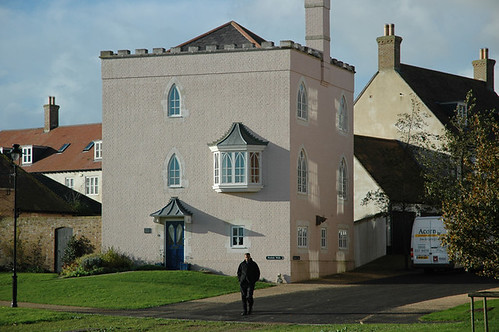
In Defence of Poundbury. Well someone had to.


(Image via)

This article by Stephen Bayley on Poundbury seems to have been picked up in various places although I can't for the life of me think why.

What does it say that we haven't heard a thousand times before? Are there any prejudices it doesn't pander to? In what way does it represent an insightful, original or interesting take on the place? Instead we are given the same old stuff about fakes and shams and pastiche.

All the cliche's are here present and correct:

It isn't honest. Oh for f*cks sake. Buildings can't be dishonest. They aren't people. They don't lie. This conflation of aesthetics with ethics is puerile. Where is the dishonesty in a brick building that looks like a traditional brick building? Truth to materials and honest detailing are part of the ideological rhetoric of Modernism and not actually fact.

It is authoritarian. Why? Above and beyond a slightly weird sense that everything is too perfect and too well maintained, what exactly is the authoritarian regime in operation in Poundbury? How does this differ from the acceptable model villages of Bournville etc.?

It is "Grimly cute". I quite like the sound of this but the article simply assumes that I won't. This is symptomatic of the stifling nature of most architectural criticism which says that I must be a heretic if I don't like the right things for the right reasons. If the term grimly cute were used in a review of an art exhibition it wouldn't be clear whether they meant it was good or bad. In architecture such ambiguity is viewed as aesthetic deviancy.

Similarly he writes:
What can be said about a presiding intelligence that demands central-heating flues be disguised by cast concrete gargoyles?
I don't know but they sound fabulous. Can I have one?

A few years ago the BBC ran a dreadful programme called Demolition* in which people could nominate the places they would like destroyed. Poundbury was one, predictably along with a number of Brutalist housing estates. The programme makers interviewed an appallingly smug character in his swish London home recounting how he would like to bulldoze Poundbury himself, a look of sadistic joy in his maniacal eyes. All this simply because it didn't meet his second hand aeshetic prejudices.

It is possible to write about Poundbury, even to write about it critically, and say something interesting, but the kind of literal, narrowly ideologial criticism of Bayley's article seems simply derivative and hopelessly myopic. And, apart from anything else, it's just too easy. Wouldn't it be more interesting to talk about Poundbury without this ideological baggage? To actually look at it and leave aside the hollow moralism? For a change. As a way of keeping things interesting.

* Brilliant concept. Maybe they should do a new series in which people could nominate which books they would like to burn.