Showing posts with label Music. Show all posts

Thursday, February 12, 2009

Is Modern Life Rubbish?


(Image via)

Yes, but here are some good things I've been reading:

Brutalism, Banham and Blur appear in recent posts at the excellent Radonbrainstorm. The post on Blur is particularly good, heroically attempting to reclaim Modern Life Is Rubbish from Britpop ignominy. Personally I'm with him all the way on this album and its "enchanting tale of lovers caught punch-drunk in the vortex of London life".

It also makes an interesting companion piece to the quite possibly definitive history of Pulp via urbanism, sexuality and class, currently underway at The Measures Taken.

I'm also intruiged by Radonbrainstorms image from '80's TV show Minder, mainly because I've missed the first episode of its return and am intrigued to see how it portrays London. London in the original Minder was relentlessly grim, a pre-Costa coffee and gentrification landscape of deserted backstreets, burnt out cars, grim clothes, gentleman's drinking clubs and British Leyland vehicles. Will it have been restyled by a combination of Urban Splash and the Urban Task Force?

Finally, Mockitecture's addictive architecture/music pairings scenario has turned up at Life Without Buildings. I'm not sure about the resulting equation of lo-fi music with primitive structures and igloos, but any excuse for some My Bloody Valentine is alright by me.

Friday, January 16, 2009

Baxter

I dunno, you nip off for a couple of days to, say, have a baby* and all manner of exciting things happen on the interweb!

First, and as if to rubbish my suggestion that he had packed up and gone home, The Impostume returns with several quite brilliant posts, the best of which is his glorious tribute to Abba. No mention of Hey Hey Helen, however, my favourite Abba break up song, particularly for its glam rock guitar, barrelling piano chorus line and the finely balanced morality of the line; "...the price you paid, to be a woman of today".

Some of this seems a response to a slew of posts at Simon Reynold's Blissblog, including this one on The Sweet.

A456 has this fascinating look at the problems of object classification when it comes to planes.

Mockitecture has a highly amusing series of comparisons between buildings and songs, my favourite of which is the collision of Peter Eisenman and Prince.

Lastly, there is a fascinating (if rather stilted) interview with the late great Charles Moore to be found down the left hand side bar at No2Self. I'm also loving Rob's AD covers, (following The Sesquipedalist's example) including the wonderful Post Modernism lift-off one linked to above (complete with perceptive Charles Moore review of Charles Jenck's Language of Post Modern Architecture -must be Charles Moore week, as he also gets twinned with Soul Train in Mockitecture's Arch/Music post) and an earlier and rather lovely Milton Keynes one.

I've learnt my lesson on billing future posts as they tend to be the ones that I never finish, but I will be up and posting properly soon........possibly.

* Yes, he (Baxter) has arrived! Many thanks for the kind words, especially from people I have never met (but now feel I should). I promise that's the last you'll hear about it. Very bad form to go on so.....I'm still a little delirious in case it isn't obvious.

Monday, November 24, 2008

And We Call Upon The Author To Explain


Taylor Parkes wrote quite possibly the best review of Nick Cave I ever read.* In it he pondered the question of how to grow old in rock music. Written at a time when Cave seemed to be freeing himself of his youthful demons and settling into something approaching middle age, the question was what could he still legitimately sing about? Alternative rock music's primary narrative is one of maladjustment, fuelled by an inability to find happiness or fulfillment. As a genre it is based around a search for the authentic personal voice of anguish or desire. If the despair (or priapic desperation) dries up then what?

Most rock musicians turn eventually into karaoke turns, literally unable to move on, stuck forever playing out a version of their youthful selves. Morrisey's return, occasionally compelling, is really only a pointless rerun of his former dazzling glory. The site of the recently reformed New York Dolls dressed up in their androgynous 1970's finery, all skinny hips and wet look leggings but with heavily lined faces and post-rhumatic moves, was both comical and sad.

In order to answer this Cave seems to have long since abandoned rock music's default setting of first person narrative - singing from the heart - and turned himself into a storyteller. Almost uniquely he sings about subjects other than himself. And he looks fabulous too, somehow both dignified and dangerous. As do the Bad Seeds. They have the look of some deranged East Berlin cabaret band descending into discordant chaos. Mick Harvey even looks a bit like Erick Hoenecker, dressed in a cheap tuxedo and playing some mix of mutant blues and white noise at the top of the Fernsehturm, while its revolving restaurant starts spinning ever faster....

As it turns out they're in the thoroughly miserable Brighton Centre on a wet Sunday night, transforming its convention hall atmosphere into something utterly and briefly fabulous.

* I think it must have been about 1994 and inevitably in the sadly defunct Melody Maker.

Tuesday, July 29, 2008

He's (not) an architect and such a lovey guy


Via The Quietus (again) you can download the estimable Jarvis Cocker's excellent Guide to Sheffield, but only for the next few days.

Thursday, July 24, 2008

paper wraps stone

I would like to bring to your attention a stylish demolition of Primal Scream's new album in excellent on line music magazine The Quietus by Chris Roberts. "The Scream" are not the most unlikely of targets perhaps and they are certainly ripe for it but Roberts manages the task with flair and elan. The line about putting a damp cloth over your intellect is particularly fine. As is his dismissal of CSS, although I actually quite like them. I'll find it more difficult to do so now though, which is the kind of perversity I take much pleasure in.

Worryingly, I haven't enjoyed reading any music criticism so much for ages. Worrying, because along with Taylor Parkes' new Fall album review, The Quietus seems to have resuscitated the entire staff of Melody Maker from 1990. They all disappeared and now they have returned en masse like veterans from a twenty year tour of duty in the Astoria. Where have they been? How did they survive? Did they all live together, like The Monkees?*

What does this say about me? That I have atrophied into the kind of man who has no sense of curiosity about the world? That I'm looking in the wrong places? Well, there is Wire and, indeed, Mire**, but I'm not sure I enjoy them in quite the same way. I feel improved, educated, more in the know, sometimes invigorated, often inspired to go and buy something. But not quite as thrilled and not quite as uplifted as by Chris Robert's delightfully rude review of Primal Scream. I had to go back and re-read it. It's still very good.

Is the enjoyment of music linked to the enjoyment of criticism? It is for me. Somehow the critical discourse around gives it meaning and a way in that I know many people would find oddy slavish to some over intellectualised form of predetermination. Actually, it's the same with architecture. In here, a great deal of what we do stems from outrage at what everyone else is doing. That is from a primarily critical impulse (the results of which probably have a similar reaction on everyone else). For me personally words and criticism precedes creativity (horrible self aggrandising word I know). But, words, perversely, are somehow important in forming things. In the anti-intellectual climate of contemporary architecture, criticism is mostly seen as a destructive thing, a necessary evil at best. Too much theory is supposed to limit creativity. In as much as I can lay claim to any creativity, I would say that, for me, the opposite has always been true

*Apart from Simon Price, who I see at every concert I ever go to. He's a very noticeable sort of fellow that Simon Price, although it might also have something to do with my wife dragging me to an awful lot of Brett Anderson concerts.

** Actually, while writing this I have been reading the Mire again and it's actually very good.

Monday, February 25, 2008

Joni Mitchell and Rudolph Schindler: Who woulda thunk it?

Oh to be Everywhere, right here, right now.

So, I’ve been reading this, Barney Hoskins’ Hotel California. I read his book on the LA music scene Waiting for the Sun a year ago on a trip to LA and loved it so much I was even moved to listen to the Best of the Eagles on the flight home. Not a mistake I’ll make again but such is the allure that the book conjures up of denim-clad hippies in charming A frame houses dotted around Laurel Canyon that anything is momentarily possible. Hotel California delves a little deeper into that same world. It’s a great book. Dense and comprehensive but suffused with love for much of the good music and righteous disdain for the crap bits (the Best of The Eagles mainly). I must confess though to a fascination for both the era and the music which is definitively not MY music or era so perhaps it is it’s alien-ness that I find alluring. I missed punk by a few years too but inherited a lot of its hatred for the hippies and in particular the multi-millionaire hippies of LA but the sun dappled lazy utopia detailed in Hoskins’ book gets to me I have to admit.

Hoskins’ was a fan of this music at the time, began to see it as inherently ridiculous through the punk era and has now come out of the closet as a full on Jackson Brown fan. The book is both besotted and critical of this wide-eyed hankering for a utopian but elitist social utopia. It wants to be bare-chested and beflared, riding around the canyons on a moped and dropping acid with Joni Mitchell but acknowledges the decadent nihilism at its heart. For a more pained articulation of this Joan Didion's The White Album tells the story of the slide from The Beach Boys to the Manson murders from someone who experienced it first hand.

The utopian appeal of LA in the ‘70’s is of course highly illusory and best summed up in the guise of David Geffen, the books unofficial anti hero. Geffen starts a record label called Asylum and convinces all the folk troubadors and singer songwriters that he is on their side, looking after their interests, only in it for the music man, and then proceeds of course to rob everyone blind. He was able to do this because it was such a small community. Hence the title of the record label. This is the interesting thing about utopias. They want to be universal and yet they are more likely to be tiny worlds, microcosms by nature. They attempt to smooth out or dissolve the harsh bump between them and the rest of the world because they are so aware that it is there. Laurel Canyon was both a model for some sense of an alternative lifestyle and a cliquey nepotistic world that was bound to implode.

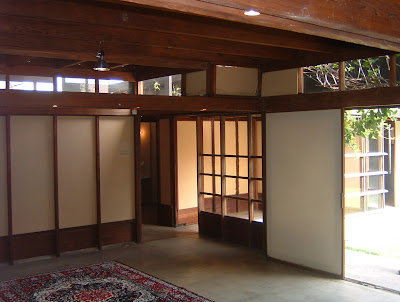
The successful LA architect Rudolf Schindler designed a house in the Hollywood hills in 1922. He built it himself, hand forming the thin concrete walls, as a house for him and his wife and another couple to live in together. The house is a beautiful and poignant spatial articulation of this arrangement and of a kind of proto-hippy social order. Two L shaped blocks pivot around a shared kitchen in a way that is simultaneously loose and highly suggestive. Each L is a mirror image of the other, as are the external spaces around them, and each drifts into the other in a way that suggests everything could very easily be swapped around and it wouldn’t matter. The external spaces are genuine continuations of the interior complete with external fireplaces and a room like sense of enclosure created by planting. The whole thing is an idyllic expression of a sense of loose connectivity and the dissolution of boundaries: social and physical. Of course it is also just one house, and one that did not last long in its initial communal couple format but it is a languorously beautiful model for how houses could be reflective of something other than the single family unit. All this designed by an Austrian, which just goes to show the power of the Californian sun. One can imagine the incestuous denizens of Laurel Canyon happily inhabiting this house: Joni Mitchell and David Crosby and Laura Rondstat and Mama Cass happily strumming away in its sun dappled spaces. In many ways it is a much more apposite and accommodating articulation of their lifestyle than the folksy traditionalism of Laurel Canyon. A genuine attempt to map out an alternative way to live through architecture.

Saturday, March 10, 2007

Kylie - The Exhibition

I’ve always found the debate over high and low culture slightly stale and irrelevant. Contrived stand offs between Bob Dylan and Beethoven bore the pants off me. Besides, I’ve swallowed enough post structuralist critiques of elitist hierarchies of value to know that popular culture is a valid subject for intellectual reflection. Plus, Put Yourself In My Place is, like, one of my favourite songs ever. So the debate about whether the V&A should put on a show about Kylie Minogue struck me at first as a non-issue, pandering to the worst kind of lazy middlebrow snobbery. Then I went to the exhibition...

Kylie: The Exhibition consists of a display of stage outfits and costumes, ranging from the mechanic’s overalls she wore in Neighbours to the bizarre Dolce and Gabbana designs of her current Showgirl Homecoming tour. Alongside these are displayed Kylie’s record covers, tour artefacts, videos, a re-creation of her dressing room and a vending machine of Kylie endorsed mineral water.

Aside from a number of text panels, there’s little commentary or interpretation and the objects are displayed in a flatly literal manner. Such labelling as there is makes a pretty lame and unconvincing case for why Kylie Minogue’s costumes should be in the V&A in the first place. Words like ‘icon’ and ‘phenomenon’ are bandied about but these terms are now so lazily over deployed as to be almost meaningless and their use here seems particularly half-hearted and pointless. The costs and logistics of putting on Kylie’s tours are listed but not contrasted with anything that might make them make more interesting or compelling or anything other than blandly impressive. Her dressing room is re-created but not to make a point, just to fill up some space. The labelling for this reaches a zenith of banality. It is, we are told; “…very special, a home away from home”. Even better than this is the information that: “..road cases are the best way to transport her extensive wardrobe”. Gosh.

The exhibition has been bought in from Australia where it was originally shown at The Arts Centre, Melbourne. It comes across as shallow hagiography without even the spitefulness of heat!, or the inadvertent vileness of Hello. It is, rather, the authorised biography.
Like her latest persona, Kylie: The Exhibition has a camp “Darling! You look fabulous” quality. This is only heightened by the cod surrealism of her Showgirls tour and her recent entry into the tragic diva hall of fame by becoming officially A Survivor. But the show achieves Susan Sontag’s definition of campness as an attempt at seriousness that fails. It wants to be culturally relevant and daringly iconoclastic, but lacks the courage or savvy to know how. It is also shamelessly sycophantic and utterly without critical reflection.

This is not about pop culture’s place in the museum. The V&A is full of pop culture already after all, and has a distinguished history of putting on exhibitions about costume and design. I didn’t dislike this show because I thought it too lowbrow, or too commercial or too vulgar. I disliked it because it was dull and po-faced and vaguely moronic. There is a thoroughly bathetic moment at the end when as you leave, you find yourself inadvertently wandering into the Medieval rooms of the V&A. From Kylie’s gold hotpants to Trajan’s column in a few steps. It’s not a flattering comparison.

Just before leaving, there is one more tribute to Kylie: a wall on which you can stick little heart shaped personal tributes. Thus in a faintly sinister way, you’re not even allowed express anything but love for Kylie. Alongside sycophantic quotes from the likes of Manolo Blahnik, Peter Huntley of the V&A has given us the benefit of his insight: “Kylie’s fun to sing along to.” Thanks Peter.