Showing posts with label Teaching. Show all posts

Sunday, November 21, 2010

the sound of breaking glass

Demonstrators break windows of the Conservative Party headquarters building during a protest in central London November 10, 2010. REUTERS/Paul Hackett 

The mainstream media has been predictably dismissive of the recent higher education protests, taking its traditional reporting stance of mocking students for being concerned purely with their own personal levels of debt. Although the creation of a vast new customer base for what are essentially sub-prime loans (as this perceptive blog post points out) is indeed shocking, focusing primarily on it misses the bigger point of how the Browne report will devastate higher eduction.

In fact, the media preoccupation with the issue of personal student debt, as opposed to the  possibility of a 100% cut (yes, you read that correctly*) in funding for arts and humanities courses, is entirely consistent with the government's objectives. Which is to say, that they propose to eviscerate any vestige of higher education as a public and civic good, replacing it with a competitive and venal market place where students run up enormous debts in exchange for promises of future earning power. Any concept that education might be about anything other than an expensive but fast track route to making money will be destroyed as a result of the adoption of the Browne report. Simply put, colleges will close, courses will cease to exist and the countries standing as a place that values art, culture and thought will evaporate with them.

This is the extent of the coalition government's aggressive and violent approach to our threadbare public, artistic and intellectual life. Faced with this, the media's hand-wringing over some petty acts of minor violence seems utterly shameful. One can only assume that the baby-boomer era editors and senior reporters who benefited from a genuinely free higher education system simply haven't grasped the extent of the government's plans and have fallen back on cliched mockery of 'violent minorities' and whingeing students.

This last issue, and in particular the emotive and symbolic importance of the broken windows of 30 Millbank, has been admirably pulled apart by Laurie Penny in the New Statesman. She also makes the very important point that the reporting of the 'riot' mirrors the shift from valuing public life to the veneration of private property embodied in the Browne Report. Clearly, the private property of the owners of 30 Millbank is held in far higher esteem by the British media than the concept of public and civic life, which can be ransacked by the government with seeming impunity. Penny evokes the suffragette movement which not only places the much denigrated 'sickening' violence in its historic context, but records the significance they placed on such symbolic acts. Now, of course, such struggles are held to be the kind of freedoms that we should be justly proud of.

The seemingly impregnable argument put forward for all this of course is that WE SIMPLY CAN'T AFFORD current levels and models of HE funding. The government's now well established trick of bandying around large figures in order to scare people into thinking that, gosh, £4.2 billion sounds a lot, much more than I have in my bank account, totally fails to place education spending in any kind of context, or offer people an informed choice of what gets spent on what. Besides, the implicit assumption is that it is not the place of government to be spending money on important services to start with. In reality, it is capitalism's insane need for growth that is at the heart of the Browne report. It identifies higher (although not primary or secondary, yet) education as an industry yet to be fully exploited for private profit.

A few other decent and thoughtful pieces of anaylsis have emerged in the wake of the protest, including this one by Stefani Collini in the LRB, which is surely argument enough for more consistent protests, whether involving the theft of a few sofas or not. Collini gets to the heart of the Browne report and its slavish importation of 'perfect market' theory into higher eduction. This despite the disasters that such ideology has already brought us and the fact that it thrives on the basic social and economic  inequalities that higher eduction is supposed, in part, to offset. In its vaunting of the power of the consumer and consequent diminution of the power of the citizen, and in its philistine misunderstanding of any value other than a purely commercial one, the Browne Report is a terrifying piece of ruthless free-market ideology.

If you are a student reading this I would urge you to get involved - if you aren't already - in protesting against the cuts and the adoption of the  Browne report's recommendations. A good place to look for news and links to organised protests is Nina Power's Infinite Thought blog, which also has a link to a petition protesting the wholesale funding cuts for humanities subjects here.

* The Browne report assumes a 40% cut in funding, but the ring fencing of science and technology subjects is likely to translate into a 80-100% cut in funding for arts, humanities and social sciences subjects. 

Monday, October 11, 2010

back to school


This is more of a catch up post really, as it's been a busy week all 'round and I've not had a chance to write up any of the things I was intending to. Plus, I've been happily watching my dear other architects post go a bit viral, attracting, it has to be said, a surprising amount of vitriol along the way. Each time I mentally start drafting a post by way of 'reply', I fall into one of the rhetorical traps outlined here, and start again...

So, Autumn term began this week and I excitedly filled up my new tutor's pencil case and headed to Canterbury. I'm taking a bit of a teaching detour this year, not so much in the subject matter - ports, transport, infrastructure, national borders - as the technique, which involves making movies. Initially these will be of the journey from Dover to Calais, but we'll also be generally learning from Learning From Las Vegas and using the camera as a proper research tool. 

In order to get things started we were lucky enough to have artist Andrew Cross come in and talk about both his work and films in general. These included C'était un Rendezvous, possibly the most macho (in a peculiarly French way) eight minutes of film every directed and one which reputedly involved director Claude Lelouch being arrested on its opening night. More to come on this extreme piece of POV filmaking in due course.....


Personally, I was in clover all day watching a series of creaky old British Transport Films, one of which was a promo for the Hoverspeed service from Dover. This 1980 production had shades of the appalling north sea ferry based soap opera Triangle and used a crude mix of sexual innuendo and mildly xenophobic jokes in an attempt to drum up a sense of inter-continental glamour. All of which, as Will Wiles pointed out in a comment on my previous post, was a desperately long way from the reality of travelling by hovercraft, which, even in the film, seemed bizarrely uncomfortable. 

A call to my parents this week confirmed that the only time I went on one of these machines was from Pegwell Bay, which I wrote about a couple of weeks ago. I finally managed to get there too, where I took the photographs accompanying this post. It's now part of a nature reserve and is really very beautiful in a bleak and gloomy kind of way. Grey plovers, oyster catchers and all manner of aquatic bird life potter around the sand banks, while the shoreline is covered by a spectacular number of cockle shells. In the background looms the derelict concrete cooling towers of Richborough Power Station, a legacy of the defunct Kent coal industry. Nearby, on the sandy marshes outside the landlocked harbour of Sandwich is the mighty Pfizer factory, a sort of priapic joke about the nature of the local economy.


I was there at low tide when the sand banks were clearly visible, small grass topped kidney shaped islands sitting like inverted golf bunkers in the mud. The concrete apron of the former hoverport has become covered by a slightly lurid green algae and, at the waters edge, provides the perfect launch pad for wading birds. While I was there a group of teenage kids were hurtling around on a very loud and very smoky motorbike which, as someone brought up in the thrill free charms of rural Essex during the glory days of the  Yamaha fs1 e, I can entirely understand.

Monday, September 13, 2010

modern archeology


I'm teaching at Canterbury again this year and have been researching potential project sites combining coastal landscapes, transportation systems and technological obsolescence. Whilst trawling the area, I came across the arcane fragment of home movie footage embedded above of the former Hoverport at Pegwell Bay, near Ramsgate.

As well as being a sort of Super 8 version of Martin Parr's Boring Postcards, the footage is notable for an eerie lack of people, as if in anticipation of the port's future demise. A vacant and overgrown concrete apron is now the only remaining sign of Ramsgate International Hoverport which closed in 1982. Google earth reveals the ruins as a strange prosthetic attachment sticking out of the curve of the bay.


Aside from the various buildings - now long gone - the port consisted of a large flat concrete shoreline, a sort of artificial beach onto the which the craft slid up before settling down on its billowing black shirts, like a large hen on a nest of eggs. In period photographs the hovercraft themselves still appear incredibly modern, alien objects in the late '60s landscape, especially compared to the Austin Maxis and Mini Clubmans that would have motored gently on and off them. Given the relative size of the hovercraft to the surrounding houses they look as if they could have just carried on past the port and inland, hoovering up the potato fields of Thanet as they went.


The word Hoverport suggests something faintly incredible too, as if tit were the ground itself that rose up and transported you somewhere exotic. Rather than Calais. The operators seemed to be aware of the ambiguous half boat/half plane character of their craft too, referring to "flights" instead of sailings and dressing the crew up as natty BOAC flight attendants. Fittingly enough high aviation fuel costs in the 1970's - combined with a susceptibility to bad weather - killed off most commercial hovercraft services. Wikipedia's entry on them concludes that "except for the Solent Ryde to Southsea crossing, hovercraft disappeared from the coastline of Britain", as if they were a species of rare bird.

Appropriately enough, the former Hoverport at Pegwell Bay is now a nature reserve. It sits on a particularly sleepy stretch of the Isle of Thanet coast, just below the plateau of Manston Airport, another, almost, failed bit of infrastructure. For those of you of a hauntological bent there are more photographs and information available here, and here. From the last of these sites I have borrowed the lovely image below. There are also photographs of the port at various stages of dereliction here.

Saturday, May 22, 2010

Myths Of The Near Future


Here's me in this month's RIBA Journal writing about FAT's recent Yale Studio. The image above is by one of our students, Aude Helene Jomini, and shows part of her proposal for a landscape for lorry drivers at Dover harbour. The building - one of several housing facilities for truckers - develops an architectural language out of lorry body parts and is adorned by a pair of giant klaxons.

Tuesday, April 27, 2010

Leaving New Haven


This is the 3rd, and most definitely final, post on New Haven. There's a few buildings I wanted to see and didn't, for various reasons, including Rudolf's Crawford Manor and the interior of the Sterling Library, so I might still get a chance to post about them individually. The picture above is of the Prague subway-ish foot tunnel below New Haven train station.

I bought a guide book this time too in a bid to avoid embarrassing displays of architectural ignorance, so expect clunking pieces of factual information strewn amidst the usual flippant nonsense.


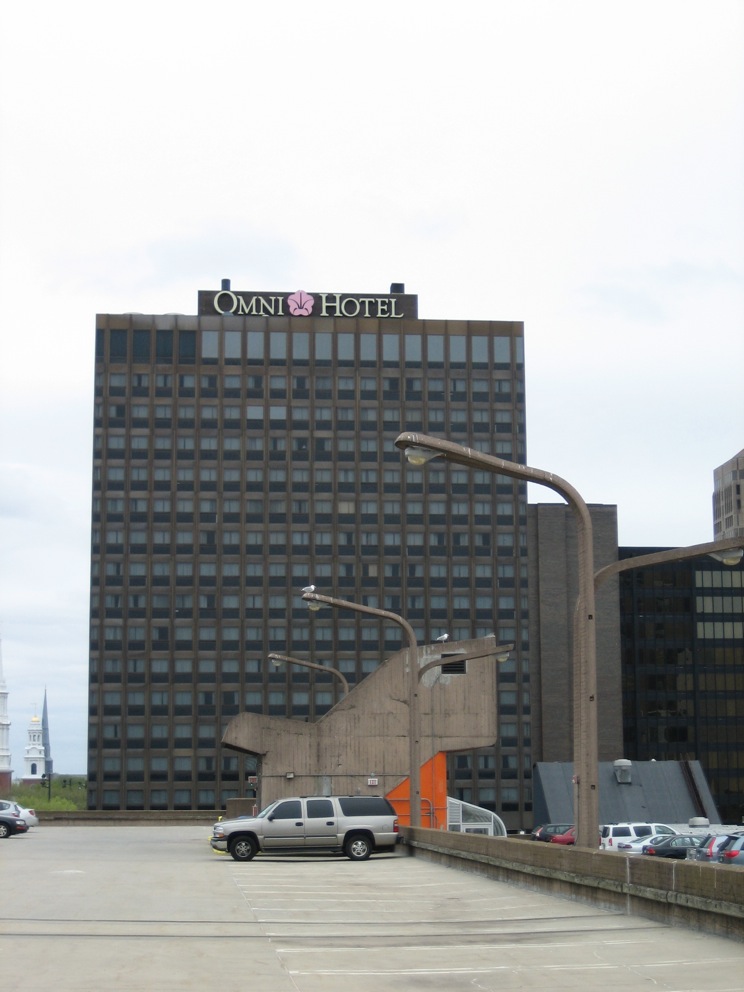
I'll start here with the view from my hotel room window of Rudolph's Temple Street Parking Garage (completed 1961, capacity 1280 cars), mentioned before and included again because it's the first time I've really been able to convey the vast scale of the building. The other thing evident in this shot is the fabulous roof-scape of miniature buildings and concrete lamp posts that look like wilting flowers, of which more later.


A photo essay of New Haven wouldn't be complete without a visit to VSBA's Dixwell Fire Station. This is officially the first ever building with a 'peeled-off corner', a device which became a cliche of Post Modernism but had one of those curiously Venturian justifications here. It's 'required' in order to get the overscaled lettering to fit the facade facing the main street, although it's clearly the case that the text was strategically sized in order to make this circumstantial gesture necessary.


One thing that puzzles people about Venturi and Scott Brown's buildings is that they really are quite ordinary. Viewed in architecture books hey have a kind of residual glamour, but seen in context they are completely at home and, almost, unremarkable. This is meant as a compliment. There is a subtlety and 'rightness' to their proportions though, even when they are deliberately wrong, that gives them a tension with their surroundings. Even so, if you spend too much time staring at this building people tend to come up to you and ask if you're lost. Or if your house is on fire.


There's also some nice low key topiary going on around the edge, and you can't say that about the Barcelona Pavilion.


Nearby is this bizarre thing, a power station built to fit in to a Greek Revival style neighbourhood now entirely demolished. In Europe, and particularly in the UK, industrial buildings from the 19th and very early 20th centuries were routinely disguised as castles and temples. This is part of the same tradition, I suppose, although it is somehow less romantic about its artifice. Unfortunately smoke doesn't emit from the twin spires although it may have once.


On the subject of artifice, I have said relatively little about the older campus buildings. They are, in parts, deeply strange, as bizarre as anything dreamt up by Anton Faust or other plunderers of the gothic. But, despite their artifice in recreating a new super-sized version of Oxbridge, you get used to them remarkably quickly.


Take a second look at this and it's actually pretty bizarre. It's also strangely plausible. Unusually too for an American city - save New York - the central campus areas of New Haven are essentially pedestrian. Between the blocks carved out by roads, the colleges unfold as a series of interlinked courts.


I'd say that the urban morphology of the campus was highly permeable if it wasn't for the fact that I would have to kill myself afterwards.


Many of the more contemporary buildings tend to ignore such picturesque niceties. Marcel Breuer's Bekton lab, for instance, sits aloof on it's own raised plaza and refuses to pass the port in the right direction.


The back of it is almost completely windowless too, making the building a scaleless, abstract object like a bit of detailing or piece of fabric pattern, blown up to a huge size.


Philip Johnson's Kline Laboratory building attempts a (broadly) modernist updating of the courtyard theme. Around the edge is a continuous colonnade that pulls together various disparate buildings into a formal whole. They sit at the top of a steep hill and this, combined with the slightly gargantuan scale, means the space has the feel of a corporate plaza rather than an informal college courtyard.


It has an odd effect too on the other buildings, suggesting that they all sit on the fat brick piloti that support the concrete awning.


The laboratory tower itself is reminiscent of Michael Graves' (much) later buildings with its chunky stripped-classical columns and slit like windows. It lies at the queasy intersection between a De Chiroco-esque distilled evocation of the classical city and bombastic neo-fascism.


Inside it's pretty grim, although not totally awful. The library is given the best space, sunk into the podium at the bottom of a double height atrium and crossed by bridges. Despite this the whole place has the air of a particularly cruel penitentiary.


Johnson's tower is oddly off axis with Hillhouse Avenue, the street running up to the mound on which it stands. From a distance it appears to be hiding, slightly bashfully, off centre-stage.


A view of Michael Hopkins' newly opened Kroon Forestry Studies building. Like a lot of Hopkins' recent projects (see Portcullis House) it has an overall weirdness which can't be contained by the Anglo Saxon rectitude of the detailing. On the outside it is clad in a skin of very new looking sandstone that is pulled away from the facade in order to make a colonnade but also to articulate - in the accepted manner - that it is not actually holding anything up. This gives the windows a voided look too in keeping with Hopkins recent goth tendencies.


Occasionally he has peeled away the stone cladding in a mock-ruinous manner in order to further reveal the artifice of the construction. He's obviously been listening to a lot of Sisters of Mercy.


Inside it is part high-tech and part Arts and Crafts with nods to the heroic Yale campus buildings of the '50's and '60's. The fare-faced concrete and fine honed timber is indebted to Kahn's British Art Centre, but the building itself is like a huge barn, more greenfield campus than urban. This is also an unflattering photo of an interesting space and the vault at the top of the building is lovely.


The high-tech meets arts and crafts theme continues with the fetishisation of glulam technology and big bolts.


Just down the hill from both Johnson and Hopkins is SOM's former Watson Astronomy Centre building which sits enigmatically behind its ivy filled moat.


Sitting at the bottom of Hillhouse Avenue is the very bizarre Cloister Hall. There are many things to enjoy about this including the stone gable superimposed on the tile one behind and the vaguely grotesque bay window bursting like a malignant growth on the left hand side.


This is a remarkable object, a cartoon piece of classical whimsy where everything is a bit fatter and rounder than it needs to be, like a bouncy castle carved out of real stone. The dummy windows are highly embellished blanks while the real ones are more low-key and largely hidden by vegetation.


It also has some very strange asymmetrical columns adding to a general sense that it might be several buildings cut and put back together in the wrong order. Or a building that got dressed in the dark.


I like a Dutch gable. And some rustication. This has both and is by McKim, Mead and White. Architecture criticism doesn't get much more sophisticated than this.


Strange, heraldic brickwork, sometimes incorporating the word Yale covered this building....I've no idea what the other signs mean although they may be something to do with a secret society.


Speaking of which, I risked my life taking this shot. It's the mysterious Skull and Bones Secret Society "Tomb". I half expected Robert DeNiro to suddenly appear beside me a la The Good Shepherd and tap me up for CIA membership. The Skull and Bones is mostly the subject of amusement rather than awe at Yale, although it still has strong links to political power. Both Bush presidents were members, as was John Kerry and Obama's current economics advisor. The building is attributed to Henry Austin who added various other bits of neo-Egyptian architecture to the campus.


The Gordon Bunshaft designed Bienecke Rare Book library appears like a colossal but very un-aerodynamic spaceship that has just landed amidst Yale's neo-medieval campus.


The library is a windowless concrete framed casket where the marble infill panels are sliced so thinly that they let light through into the interior. It sits enigmatically in a granite plaza from which the building's columns seem to grow.


The soffit around the entrance is notably low and hangs slightly menacingly above your head as you enter.


The inside is very beautiful and has a misty quality reminiscent of Renaissance churches where the precise edges of the room are hard to make out. The strangely corporate furnishings though also give it the feel of a sensationally upmarket hotel lobby.


This it turns out is by Charles Moore, or at least the office of Moore and Turnbull. When it was completed the air-conditioning grills to each apartment were painted in different colours, although they have faded now leaving the building unremittingly grim. My guide book said something about the top row of windows forming a vestigial cornice, which is generous.


Across an asphalt car park from the Moore building is this somewhat creepily blank church with a roller shutter entrance door...


...guarded by someone in this little hut who's been using a lot of gas.


I took this shot for Lang Rabbie, who asked in a comment to a previous post whether Kevin Roche and John Dinkerloo's Yale Nursing School was still there. It is, although it appears to be sinking.


Back on the roof of Rudolf's car park I got very into the concrete folly-like service towers. The lean to greenhouse is new I assume but the bright mosaic tiles are original. The lamp posts are also very elegant, made as if from a thin strip of concrete that has been peeled apart like a banana...


The interior is fabulous vortex of clashing concrete decks and vaulted tunnels and an excellent location for a car chase.


The height of the roof is also almost exactly aligned with the various church steeples that sit along Temple Street (so called for that reason), giving them an odd, almost domestic quality when viewed so close up.


A seagull gazes mournfully out across New Haven towards the port and Marcel Breuer's vacant former Armstrong Rubber Company building stranded by the freeway. Next to it is a vast Ikea which sometimes uses Breuer's building as a billboard.


And finally, a shot back to the good old Omni Hotel. I shall miss its heavily patterned interior and scarily large apples in the lobby.

Monday, February 15, 2010

Shifting Units and Value-less Engineering


JJ Charleworth's recent Mute article about the ICA's severe financial problems is well worth reading. In it he dismantles Ekow Eshun's cynical attempt to blame the institutes's problems solely on the recession. He also takes Eshun to task for his attempt to turn the ICA into a "more fluid and decentred model of arts presentation" as opposed to a boring old (modern) art gallery.

Charlesworth identifies an insidious New Labour rhetoric of anti-elitism behind Eshun's plans (an issue expanded on by Mark Fisher in this piece). In this schema arts institutions are required to become hip, flexible concerns un-encumbered by too much in the way of permanent staff or collections or any of that fusty old nonsense. At the same time, an expensive new tier of bureaucracy is required to chase sponsorship and new business opportunities.

Such a model has, of course, more or less taken over all artistic institutions and activities as well as hospitals, schools and universities. It follows the way that professional expertise has become systematically devalued in the new landscape of project management and bureaucratised capitalism, replacing it with endless targets and organisational procedures.

Like most professions, architecture too has become increasingly commercialised over the last thirty years in ways ranging from the small - being able to advertise - to the more fundamental - such as the co-opting of the architect's traditional role by project managers and cost consultants.

Obviously this marginalisation reflects the wider shift from the post-war consensus of welfare state paternalism to the corporate culture that has permeated every area of contemporary life. But to stick to architecture for a moment the interesting thing for me personally is how this corporatism has taken place over the course of my educational and professional life.

When I was studying in the early 1990's architectural education had just been through a radical shift from the pedagogical certainties of modernism to the multiple strands of post-modernism. Gender studies, queer-theory and all sorts of other strands imported from cultural theory were undermining the supposed certainties of modernism and re-reading its critical canon. Alongside the functionalist and anti-decorative aspects which had already come under fire from post modernism, modernism was being critiqued for its paternalism, (too many dead white men) and its suppression of the psychological and political complexities of space.

The result was a splintering of any consensus as to how to teach architecture and a consequent embracing of pluralism and diversity. This pluralism found its most obvious form in the 'unit' system of teaching, where students choose from a menu of tutor groups at the beginning of term, each with their own singular agenda and interest area. From within the teaching establishment this breakdown into atomised tutor groups has been seen as both an unquestionably good thing and one motivated by cultural as opposed to economic goals. Viewed from afar though it might not be so clear.

The Unit teaching model was made popular at the Architectural Association in the 1970's with its panoply of rising stars all using teaching as a platform from which to launch their stellar careers. The AA - being a private fee paying school - has always had a unique culture, but during the 1980's and '90's its unit system of teaching became adopted - to a lesser or greater extent - by pretty much all UK schools of architecture. This has coincided with a downsizing of full-time faculty staff, who have been replaced by a shifting army of part-time design tutors.

The unit system as propagated at the AA was always a somewhat ruthless exercise that mimicked free-market economics. If a unit wasn't popular with students then it was likely to face the chop. Despite the obscureness of the subject matter offered by each tutor a certain ruthless populism underpinned the whole enterprise. At the AA, its reputation for providing a gallery of star tutors for students to choose from guaranteed an intense level of competitiveness. At less well resourced schools of architecture the adoption of the unit system has resulted in less obviously useful results.

That's not to say that there isn't a lot of value in the unit system, or that it's entirely venal in its motivations. Far from it in most cases, but the shift in teaching culture has undoubtedly been expediently useful for universities, allowing them to reduce their staffing levels whilst seemingly offering more choice and diversity. The process might not have originated with market economics but, in some ways, they underpin it as much as theoretical ideas about the dismantling of modernism.

The incorporation of the rhetoric of choice within the internal teaching methodology of architecture schools has mirrored a wider shift in higher education where universities now offer products and services to customers as opposed to courses to students. What's more the upcoming enormous slashes in higher education budgets will no doubt be easier to execute with fewer full time members of staff to expensively sack.

Not only that, but the air of intense competitiveness it generates must surely help prepare the ground for the way that architects are forced to win work. Increasingly, clients ask for levels of unpaid work up front in the form of mini-competitions that force architects to fight ever harder amongst themselves for work. A risk-averse culture, combined with the kind of layers of bureaucracy that Fisher identifies, means that no one is prepared to simply hire an architect based on knowledge of their previous work. Instead, architects have to bid for work by completing a large chunk of it at their own risk whilst competing with other firms to offer the lowest fee.

Of course, the language of corporatism has permeated architecture beyond education in much more obvious and well-documented ways. From the endless insistence on Best Value to the ruthless way that architects are employed by sophisticated developers, architecture is forced to play within a very particular economy. Successful architects - ones with work - have learnt to negotiate this culture, able to squeeze the architecture in amongst the net to gross ratios and talk of retail offers.

The rhetoric of partnering that resulted from the 1994 Latham Report (in an attempt to make construction less confrontational) has only made this situation worse. On the face of it the report was an eminently sensible set of objectives that no right thinking person could object to, an attempt to reduce confrontation in the notoriously litigious construction industry. Like all eminently sensible things though it is a smokescreen of reasonableness obscuring a deep ideology.

The idea of partnering is flawed for most architects simply because their values are not shared by other members of the construction team. What partnering usually means is a victory for the model of economic efficiency that all partners have to sign up for. If design has a place in partnering agreements it is usually a mealy-mouthed commitment to 'design quality'. In reality, the tenets of value-for-money, efficient supply-chains and risk-free construction come to bear on the design process at an ever earlier stage. This results in the creation of the monstrous and horrifying term Value Engineering, a notion that all architects now have to sign up for that commits them to a continual search to find a cheaper solution. The possibilities for architecture as a cultural act are progressively squeezed out by the need to prove that cheaper and quicker options have been explored at every available opportunity.

An American friend said recently commenting on another blog how shocked he was by the extent to which the RIBA had swallowed the rhetoric of project manager business speak. None of this is news of course and much of what I've said is the perennial subject matter for RIBA conferences and the AJ letters page. That I've ended up here doing the same after years of denigrating the stuffy old RIBA is ironic and, possibly, highly predictable.

As a student, one of my tutors wrote a book based around the death of the architect. It critiqued the RIBA's jealously guarded professional (self) interests and proposed the slow collapse of its Portland Place headquarters. At the same time, I was designing an alternative home for, of all places, the ICA, hidden in the left over spaces of the National Gallery. The projects flip solipsism would, no doubt, have appealed to Ekow Eshun.

All fair enough, but in the rapacious value less terrain of financial deregulation, the soft paternalism of professional knowledge suddenly seems enormously important.