Showing posts with label architecture. Show all posts

Thursday, October 14, 2010

fables of the reconstruction

At the end of his brilliant essay on the Barcelona Pavilion – Mies Van De Rohe’s Paradoxical Symmetries – Robin Evans added a short post-script dismissing concerns about the buildings authenticity. The original Pavilion was built for the 1929 International Exposition in Barcelona and demolished shortly after. The building that Robin Evans visited was a reconstruction, completed in the 1980's.

Architecture differs significantly from other art forms in that the final product - the building - is made by people other than the architect. Architects - along with the other members of the design team - really only produce a very complex description of the building, not the thing itself. Although there are questions of authenticity that reside in the manner of a building's construction - that is, in the way that it has been made - artistic authenticity is part of a wider set of issues to do with the buildings relationship to time and place.


The  concept of the zeitgeist is central to the rhetoric of modern architecture. The belief  that buildings should embody the 'spirit of the age' assumes that they can be the logical outcome of the contemporary forces that bring them into being. Such a belief in modernity and in the duty of art and architecture to express the unique conditions of its own period is clearly antithetical to reconstruction. To be authentically modern, one can't recreate the past.

In recent decades a small number of highly significant 'lost' buildings - including the Frauenkirche in Dresden and the Cathedral of Christ the Saviour in Moscow - have been reconstructed. Unlike the Barcelona Pavilion, the return of these buildings is clearly more a political issue than an aesthetic one. Their re-appearance is an attempt to heal the scars of war or a way of rejecting the political ideology that removed them in the first place.


There can't be a site that better represents the vicissitudes of the twentieth century than Christ the Saviour. It lies in the centre of Moscow, close to the Kremlin and on the banks of the Moskva river. The original cathedral was constructed on this site in the mid-19th century. It was demolished in 1931 in order to make way for the enormous Palace of the Soviets. Only the foundations for this building were completed though and, after lying dormant for years, the site was turned into an open-air swimming pool. Then, in the last decade of the 20th century the cathedral was re-built, an immaculate copy of the original that was consecrated in August, 2000. To complete the return to a pre-revolutionary condition, the cathedral was the venue for the glorification of the last Russian Tsar as a saint.


In a sense, this story is almost too perfect an encapsulation of the retrogressive nature of reconstruction, far too neat a fable. The cathedral hasn't been rebuilt for any architectural qualities it might have had, although, like all cathedrals, it is impressive and awe inspiring when inside. It's reconstruction is a matter of attempting to erase the political events of the 20th century from the site, which from an architectural point of view seems a massive shame. The vast, circular Moksva swimming pool looked like a fabulous constructivist object, a gigantic circle from a Malevich painting spinning through the thixotropic space of the city.

Unlike books, or films, or paintings, a new building usually means the destruction of a previous one. Buildings replace each other, sometimes wrongly, and their conservation is a highly problematic issue because they always mean something to someone. In a sense, reconstructions compound the insult by demolishing the buildings that result from previous demolition. They attempt to rectify the violent erasure of the distant past by erasing the  recent past.


The reconstruction of Christ the Saviour is an attempt to erase the crimes of Stalin, quite specifically as it was he who ordered the cathedrals destruction. Yet, re-writing history is a cliche of Stalinism. The re-built cathedral assumes that nothing of worth existed on the site and that nothing was lost in its reconstruction. The missing swimming pool has become like the people removed from official photographs and history books.

All of which assumes that buildings only exist in their physical form, rather than as a memory, or a photograph or a story. The Barcelona Pavlion only existed as such fragments for many years. It's canonic status within architectural history rested on a handful of black and white pictures and a few drawings. Arguably it's importance was, at least in part, a result of its inaccessibility. Buildings are sometimes more powerful in their absence. Certainly, its easier for a clear narrative to be developed when there is nothing left to contradict it. The perfection of the Barcelona Pavilion was preserved because, for fifty years, it never grew old. It's reconstruction allowed Robin Evans and others to reassess its qualities and contradictions, sometimes radically so.


It's hard to make a case against reconstruction on the grounds of being true to the zeitgeist. Such a position assumes a reductive relationship between technology and form. What happens for instance if the spirit of the age is nostalgic, or inherently reactionary? Ultimately, the argument against reconstruction might be same one as for any building. What does it replace and is it worth it? The Barcelona Pavilion replaced nothing but itself. The site had remained empty and the rotting foundations found in the ground were that of the original. It's tempting to suggest that these should have been retained as a ruin, a genuine preservation of the original. But this is simply another kind of sentimentality, an aestheticisation of the past that merely speaks to a melancholic rather than optimistic frame of mind. It's not so much the ersatz, or inauthentic nature of reconstruction that is the problem, more the futility of the gesture.


A restoration debate has been rumbling away in London these past few years. The Euston Arch was demolished in 1961 and, ever since, there has been a consistent campaign to have it rebuilt. Positions are polarised, and over rehearsed to the point of meaninglessness. But there's always been one detail I've found intriguing about the story which is that the stones from the original arch lie at the bottom of the River Lea. Parts of these remarkably well preserved columns and classical details have already been raised from the river. The proposal now is to literally rebuild using the salvaged material. No doubt if the plans go ahead the stones will be cleaned and repaired and the missing parts remade to complete the whole. As all reconstructions are representations of history though, maybe a more truthful picture would be to only use what can genuinely be reclaimed. The result, with its holes and gaps and stains might be a more compelling, and more genuine, record of the building's history.

Monday, October 11, 2010

back to school


This is more of a catch up post really, as it's been a busy week all 'round and I've not had a chance to write up any of the things I was intending to. Plus, I've been happily watching my dear other architects post go a bit viral, attracting, it has to be said, a surprising amount of vitriol along the way. Each time I mentally start drafting a post by way of 'reply', I fall into one of the rhetorical traps outlined here, and start again...

So, Autumn term began this week and I excitedly filled up my new tutor's pencil case and headed to Canterbury. I'm taking a bit of a teaching detour this year, not so much in the subject matter - ports, transport, infrastructure, national borders - as the technique, which involves making movies. Initially these will be of the journey from Dover to Calais, but we'll also be generally learning from Learning From Las Vegas and using the camera as a proper research tool. 

In order to get things started we were lucky enough to have artist Andrew Cross come in and talk about both his work and films in general. These included C'était un Rendezvous, possibly the most macho (in a peculiarly French way) eight minutes of film every directed and one which reputedly involved director Claude Lelouch being arrested on its opening night. More to come on this extreme piece of POV filmaking in due course.....


Personally, I was in clover all day watching a series of creaky old British Transport Films, one of which was a promo for the Hoverspeed service from Dover. This 1980 production had shades of the appalling north sea ferry based soap opera Triangle and used a crude mix of sexual innuendo and mildly xenophobic jokes in an attempt to drum up a sense of inter-continental glamour. All of which, as Will Wiles pointed out in a comment on my previous post, was a desperately long way from the reality of travelling by hovercraft, which, even in the film, seemed bizarrely uncomfortable. 

A call to my parents this week confirmed that the only time I went on one of these machines was from Pegwell Bay, which I wrote about a couple of weeks ago. I finally managed to get there too, where I took the photographs accompanying this post. It's now part of a nature reserve and is really very beautiful in a bleak and gloomy kind of way. Grey plovers, oyster catchers and all manner of aquatic bird life potter around the sand banks, while the shoreline is covered by a spectacular number of cockle shells. In the background looms the derelict concrete cooling towers of Richborough Power Station, a legacy of the defunct Kent coal industry. Nearby, on the sandy marshes outside the landlocked harbour of Sandwich is the mighty Pfizer factory, a sort of priapic joke about the nature of the local economy.


I was there at low tide when the sand banks were clearly visible, small grass topped kidney shaped islands sitting like inverted golf bunkers in the mud. The concrete apron of the former hoverport has become covered by a slightly lurid green algae and, at the waters edge, provides the perfect launch pad for wading birds. While I was there a group of teenage kids were hurtling around on a very loud and very smoky motorbike which, as someone brought up in the thrill free charms of rural Essex during the glory days of the  Yamaha fs1 e, I can entirely understand.

Monday, October 4, 2010

maxxied out

The Stirling Prize has elicited more than its usual amount of brouhaha, or perhaps I've just been paying more attention this time. Twitter doesn’t help, of course, turning even watching the prize giving at home into some kind of media event. The programme’s every detail, (Tom Dyckhoff’s costume changes, the awkward interviews with the judges and Zaha Hadid’s truly remarkable outfit) were all subject to an instant barrage of enthusiastic opinion.

Su Butcher at Just Practicing was particularly quick on the draw, posting a humble practicioner’s critique of all the self-congratulatory hoopla and asking the leading question: “What do you think of the Stirling Prize?” To which most people replied, predictably enough, that it was a load of pretentious nonsense. Most wondered too why the prize is awarded exclusively to the architect, when so many other people contribute to the construction process.

Leaving aside the fact that the Stirling Prize is a prize specifically for architects, it’s not a bad point. The prize is, after all, for the best building of the year. Architecture is a profession with a very odd relationship to its end product, which it views simultaneously as both the exclusive outcome of the architect’s will and somebody else’s problem if anything goes wrong.

Partly this has something to do with the way architecture is produced. While fine art is still nominally made by the artist (although this is, of course, not always the case), architecture is the product of many hands, none of which, physically speaking, belong to the architect. Architects make drawings, after all, not buildings. Even allowing for the incorporation of ready-mades and industrialised processes into contemporary art, it’s difficult to think of another artform where the author is so removed from the result.

There is an enormous gap between the process of designing and the physical reality of building. Architects get so used to equating drawings and models with buildings – despite the vast scale, material and factual differences – that they assume an equivalence between them. Perhaps it is this sense of equivalence that allows them to gloss over the work done by other consultants and contractors and claim sole authorship. This equivalence affects architectural education in particular, where buildings and images are discussed as if they are literally interchangeable. 

Architecture involves projection, both literally and metaphorically. When architects design they are involved in an active process of imagining buildings and objects that don’t, as yet, exist. But the mediation of architecture continues to conflate image and physical reality. The accusation that architects are somehow aloof or arrogant stems, I think, from this sense of removal, the fact that they simply don’t get their hands dirty and conceive of architecture from the rarified realm of their ivory tower.

All of which is ironic to say the least given the decreasing influence architects have in the construction industry. The last fifteen years may have witnessed a construction boom but it also saw a steady slide in influence of the general practicing architect. I have ranted before about this in connection with the Carbuncle Cup – the anti-Stirling Prize if you like – and suggested that the glamour and fuss surrounding the event seems to grow in inverse proportion to the number of decent buildings completed in general.

Perhaps this explains the choice of winner too. Zaha Hadid’s Maxxi is unmistakably a big work of architecture, at least in the sense that architects conceive it. It is large, culturally important, bold, structurally audacious and undeniably the singular result of its author’s vision*; a Gesamtkunstwerk that looks better minus the addition of any kunst. Maxxi represents the good ship architecture sailing serenely through a sea of PFI detritus. Perhaps, in the end, the judges considered a reaffirmation of the eternal values of architecture more important than the localised political point of celebrating new school buildings.

This is debatable, not because Zaha’s building isn’t amazing, but because the coalition government couldn’t have done more since it came to power to kick the construction industry well and truly in the nuts. For an industry largely surviving on publicly funded projects, cuts in grants for affordable housing plus the binning of BSF have had devastating results.

In Saturday’s Guardian, Polly Toynbee criticised professional bodies in general for staying silent on the issue of cuts. While the unions take the rap from the right wing press for opposing them, professional bodies like the RIBA seemingly have nothing to say, despite the impact on its members. Instead, the RIBA organises conferences like the recent Does Beauty Matter at which key note speaker John Gummer made predictably philistine remarks about Brutalism and revelled in the privilege of his experiences with classical architecture.  It’s hard, in the current climate, to take this kind of thing with good grace.

Ultimately, the Stirling Prize is not entirely reducible to economic/political arguments, although it is inevitably tied up with them. There are clearly other criteria for judging works of architecture than how well, or badly, they reflect the times. But shying away from any kind of political context is something that architects and the RIBA do far too much of. Perhaps as a result of this, Maxxi seems thoroughly out of time, a grand piece of prog rock in the post punk landscape of public spending cuts.


* This leaves aside the interesting question of Patrick Shumacher’s contribution, an issue highlighted awkwardly by his slightly unexplained presence on the stage during Hadid’s acceptance speech. Clearly, it would be too complex to admit that even architectural geniuses have help.

Tuesday, September 7, 2010

days in toyland


Will Self wrote a piece in last week's Guardian Review about his interest in scale and love of miniatures and models. I'm not a huge (ho ho) fan of Self's writing but I do remember enjoying his short story called Scale - about a man who lives in a bungalow adjacent to Bekenscot Model Village - and I share his obsession with the subject.

Miniatures and models seemed to feature in my recent holiday to an unnerving degree too. It was the sort of thing that might happen to a character in a Will Self story, in fact, someone slowly losing their sense of scale until they become stuck in a terrifyingly cheery miniature world populated by old ladies on stationary bicycles, firemen forever putting out the same fire and aeroplanes unable to take off.


All this can be partially explained by the fact that I spent my holiday by the English coast
. Seaside towns in the UK are home to numerous miniature golf courses, model villages and small-scale steam railways. On holiday the routines and objects of one's working life are replaced with larger - or smaller - than life versions of reality.


The Romney, Hythe and Dymchurch Railway is a 15 inch gauge steam railway that is also a working piece of infrastructure: a functional toy. Its trains puff alongside the sand and shingle beaches between Dymchurch and Dungeness, transporting holiday makers - and others - along 13 1/2 miles of the East Kent coast.


What's interesting, and a little bit odd about the RHDR is that its journey is for the most part thoroughly un-picturesque. The sea is always nearby but rarely visible and the trains rattle along past suburban back gardens, through flat and undramatic farmland and, finally, across the bleak shingle spit of Dungeness. The fact that the final destination is a nuclear power station seems oddly fitting. It takes a long time too - over an hour - to complete one leg of the journey and it is not, in any particularly obvious sense, entertaining.


In some of the gardens en route residents have built miniature stations with platforms occupied by smiling and waving garden ornaments. Some have gone further and built their own miniature railway. There is a pleasingy Doctor Who-ish quality to all this, a series of ever diminishing scales that may well end in an infinitesimally tiny train set hidden under a skirting board and capable of tilting the earth off its axis. Possibly.


Everything associated with the RHDR railway is built to the same scale and with the same degree of thoroughness so that to take a journey on it is to effectively occupy a series of spaces that you don't quite fit into. Judging distance and speed stops being a matter of habit and becomes oddly foregrounded so that it takes a degree of mental effort to work out how far or near things are away from you. The whole place is mildly disorientating in way which betrays its origins in the Edwardian whimsy of Peter Pan and The Wind In The Willows.


Equally, there is a matter of factness about it all, and the pragmatic day to day activities of a railway - the repair sheds and stacks of replacement sleepers and even freight engines - are realised at the same scale without a hint of kitsch.


We didn't make it as far as Dungeness and got off at New Romney, which was fine because it meant that we could visit the New Romney Toy Museum. Well, it wasn't entirely fine because New Romney station is in the middle of nowhere, several miles from either a beach or town, neither of which are much to write home about when you get there. The museum itself was small but normal scale. It also answered A A Gill's recent criticism of Bethnal Green Museum of Childhood (not enough guns) by being more of a Boy Museum, filled with toy cars, trains, rockets and steam radios.


There were also models of docks and industrial ports, power plants and cooling towers, all sorts of things in fact that no one would dream of making a toy of now, and not only because they increasingly don't exist (well the industrial ports at least). There is something about the specificity and literalness about old toys that makes them fascinating. They are not even toys exactly, at least not in the contemporary sense of things that are fun or immediately entertaining. They're closer to educational objects, factual representations of industry, science and technology as opposed to the spectacular and fictional ones of today.


That's not to say that they didn't contain a science fiction element but that, when they did, it was usually with a jolly and optimistic tone that its hard to see in Transformers or, most especially, something like Wall-E. I particularly liked the stylish 2000AD style font of Computacar's packaging though, and the inference that in the future there will be no 'E's'.


The museum also had an extensive miniature railway all of its own, a Hornby sized version that wound itself around the room in a fantastic display of the amateur model makers art.


The model represented a collapse of both space and time. Men in 1970's suede car coats parked up their Ford Cortinas to watch pre-war steam trains rattle through a countryside caught in some mid-twentieth century idyll. Elsewhere, 1950's cars and caravans set up camp next to gas cylinders and power station cooling towers...


For some reason this scene reminded me of David Fincher's film Zodiac. Something sinister lurks in those miniature bushes.


The museum also contained historic photographs of the light railway. It has, at times, been used to transport ballast, fish, army troops and the Royal Mail. When it was extended - in 1937 - to reach Dungeness, Laurel and Hardy were invited to open the new line. More bizarrely still, it formed a part of the defence of the Kent coast during WW2, when a miniature armoured train would patrol its length.


Outside the museum parked in the New Romney sidings was a model of the armoured train - another model of a model in fact - a plywood replica painted in silver that is slowly flaking off.


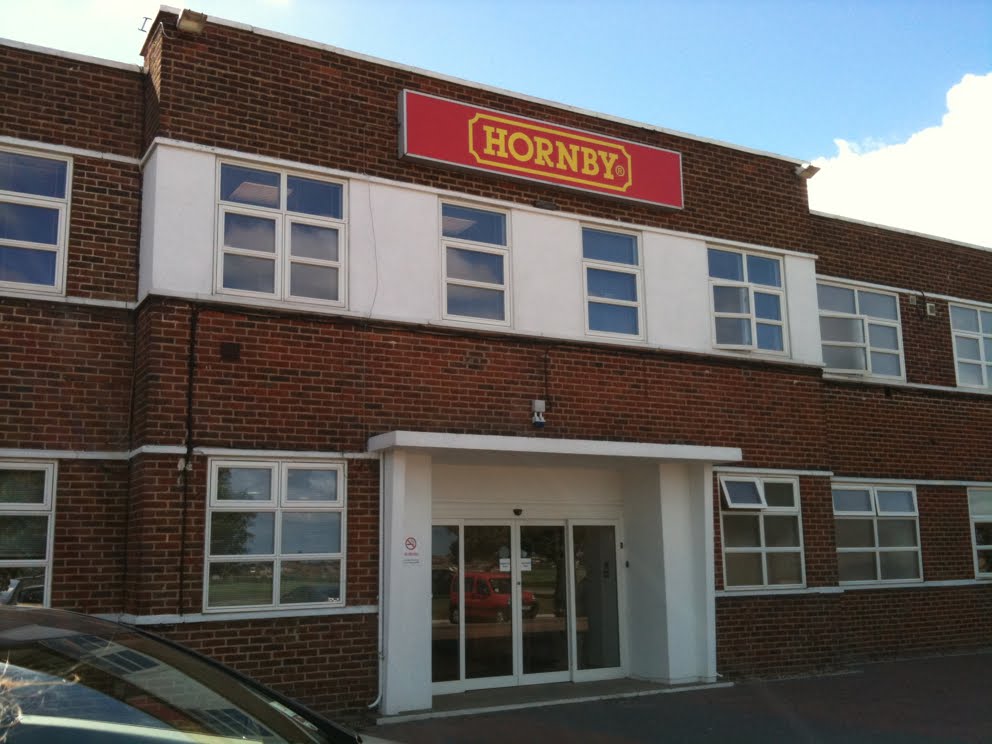
A few days later, and back using regular sized transport we passed Hornb's rather Sun-shine Deserts-ish stripped deco factory outside Broadstairs. The factory has a visitor centre attached now so we decided to follow in Bernard Cribbins' Hornby sized shoes and immerse ourselves in its miniature world.


Inside they had created a slightly menacing and under-populated night-time scene of a northern English city. A couple argues on the street...


...while trucks pull up at an all-night distribution warehouse.


The moulds for the cars were in many ways more interesting than the toys themselves. Their opaque windscreens and the way the shapes emerged from solid lumps of plastic was oddly disturbing and reminded me of Richard Prince's car body part sculptures.


But there was something very beautiful about the older toys themselves, often a result of the relative crudity of earlier modelling techniques. Some of the ones from the 1950's and early '60's had an absence of detail that made them seem semi-abstract, more like expressionist impressions of speed and aerodynamics than accurate models.


Other exhibits seemed imbued with the specific obsessions of previous eras, like this little collection of 1970's outdoor camping chic. Behind the Bond Bug and the lady on the sunlounger is a set of safari park vehicles from Longleat or somewhere similar, surely something no one would consider making a toy of today.


I bought myself a present from the gift shop. It was the most humdrum and wonderfully mundane object I could find; a Car Sales Portacabin. My wife looked at me somewhat pityingly when I showed it to her and asked if I had anything else I wanted to admit to.


A fondness for models and miniatures is a dangerous thing to admit to. There is an un-worldliness to it, a sense of childish retreat from adult concerns. No doubt there is an element of truth to this, but I also like the uncanny qualities of models and the fact that they are frequently and interestingly wrong.

Because miniatures (and giants) are translations - that is, versions of other pre-existing objects - something tends to get lost - or added to - along the way. So, models are as much about how we see things as they are objects in their own right. Making an object at the wrong scale removes it from the real world, so that it becomes an object of contemplation, a way of reflecting upon the things that we normally only experience in a blur of habit.

That's my excuse anyway.