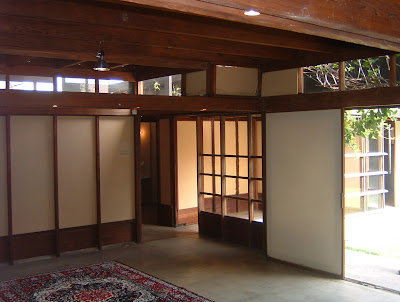
Architects have a periodic desire to escape architecture, to find a place without the (inhibiting, divisive) culture of building. There is a counter history to architecture which is an attempt to remove these divisions, take away the walls, and make the spaces in which we live continuous with the ‘natural’ world.
The high tech architecture of the sixties. in its attempt to dematerialise architecture, also developed a corresponding idea of a pastoral idyll in which we might dwell happily as noble savages. New technology would allow us to live in a kind of techno-primitive symbiosis with nature. In this sense high tech could be seen as an attempt to make an innocent paradise, a garden of eden.
This was in many ways a uniting of the counter culture’s embracing of the pastoral (think Laurel Canyon in LA) with the same era's love of space race technology. So, rather than start with the normal origins of high tech – modernism’s fascination for industrialisation – we might start somewhere else for a change, with its love of the bucolic.
The following is a series of pictures linked by certain similarities.

In his painting Mr and Mrs Andrews, Thomas Gainsborough depicts a wealthy landowning couple. They pose, stilted and unnatural, in the landscape as if they were in their own drawing room. The countryside around them appears as a benign extension of the domestic realm. Comically, absurdly, they are trying to look as if they belong, that they are a natural part of the land and it a natural part of them. Their house and the social structure behind is invisible, absent from the wholly unconvincing depiction of a bucolic idyll.

Another couple, almost as stilted and awkward as the previous one, sit inside a house shaped like a sphere. The stiff poses, Eisenower era haircuts and old fashioned furniture appear incongruous in this radical bubble which in turn fits strangely into its setting of suburban Illinois in the late 1950’s. The man is Buckminster Fuller who designed one of the most extreme examples of dematerialised architecture ever; a glass dome to envelop the whole of Manhattan. In this proposal architecture is erased almost entirely so that it becomes a device for modulating the atmosphere within it, a phantom enclosure that is invisible but all controlling.

A long-haired barefooted couple wander away from us, along a gridded pathway through a desert like landscape. They look like refugees from Woodstock, on some kind of pilgrimage. This is a montage of Superstudio’s Continuous Monument, an epic scaled but physically minimal intervention. Architecture here is reduced to an abstracted grid, the merest suggestion of building, the last vestige of a technocratic culture.

Inside this bubble perched over a vestigal bit of landscape sit another unlikely Adam and Eve. One of them is Reyner Banham, the architectural critic and ‘godfather’of Brutalism, the other a French artist called François Dallegret. In the centre of the bubble is a complicated looking machine that looks after the temperature and atmosphere inside. The bubble represents the barest hint of a boundary, an elegant looping line of enclosure that suggests that as far as these two are concerned, they are out in the open, at one with nature.

Archigram's work flirted most obviously between a love of high tech gizmos and a more dreamy idea of escape from architecture.
David Greene’s Rockplug and Logplug seem to anticipate a similar sort of serviced landscape. These are among the most intriguing and suggestive of Archigram’s inventions. They are electrical devices camouflaged into the background but supplying all the creature comforts of the indoors. There is more than a hint of the Flintstones in their conflation of natural forms and modern conveniences.
Similarly his L.A.W.U.N projects suggest robots that could track over the landscape to deliver our needs straight to us. Here, a slightly different idea of escape is suggested, with Eve replaced by a TV set, which suggests that our technology might also divide us. These projects try to eliminate the stuff of architecture, its heaviness, its history, its tedious sense of the permanent, replacing it instead with invisible fields of electronics that provide us with comfort and entertainment.
These trajectories are linked both by their rejection of architecture’s physical, material properties and by a desire to throw off other less tangible restrictions. But also they suggest a return to some kind of Eden-like stage, a desire to get back to a more primitive state of being. Like much science fiction, this primitiveness is mixed curiously with new or as yet unrealised technology. Buckminster Fuller and his wife could not be more different from Banham and Dellegret. But Fuller’s radical experiments in a dematerialised, de-historical architecture, would be taken up by more socially radical architects a decade later.
This tendency within architecture has largely petered out, replaced by a renewed interest in the monumental and the bombastic. The idea of architecture as both socially liberating and, in some way, about a kind of loose limbed pleasure seems to have been abandoned.
When space is talked about now it is almost entirely in a formal, sculptural sense. Not the bit that we are actually in. In abandoning classical notions of inside and outside, the definition of architecture as a series of rooms and physical enclosures, the high tech architects and their lineage, looked at space as a benign landscape in which we are free to do what we want. With remote atmospheric controls in place to modulate temperature, climate and air and provide services for our high tech toys, we are able to organise ourselves however we want. The reason we went into the cave was because of the hostility of the atmosphere around us. Protect us from that and we can step back out and the world becomes our paradise again.

Some of these dreams have been fulfilled even though they may not have affected the houses we live in. Neither have they ushered in the more utopian social structures implied by and dreamt of by the 60’s avant garde. The technologies of communication and entertainment depicted in these drawings have become something we carry around with us so that we do, in a sense, always inhabit a vast landscape of social interconnectedness.
In visions of the future it is assumed that all technologies and all aspects of life keep a parallel pace of development. In reality though the dizzying effects of digital culture have left our physical culture way behind, changing our understanding of space without in-effect changing its appearance. Today’s architectural avant-garde tries to give form to that effect, rather than looking at the effects themselves. We may inhabit the same dusty old rooms but we are also, in effect, many thousands of miles away, and nearby too. Simultaneously.